
Choosing a mobile carrier used to be simple. You picked the one that worked at your house. But today, the battle between Verizon Wireless vs US Cellular is about more than just signal bars. It is about a massive industry shift.
If you are reading this, you are probably in a very specific situation. You likely live in a rural area, maybe Wisconsin, Iowa, or Maine, where UScellular has been the “local hero” for decades. But you are seeing Verizon Wireless ads for blazing fast 5G, and you are wondering if it is time to switch.
Or, you might be hearing the rumors about T-Mobile buying US Cellular and wondering, “Is it even worth signing up for US Cellular right now?”
This isn’t just another generic comparison. We are going to break down the difference between US Cellular and Verizon Wireless with a focus on value, future-proofing, and real-world coverage. We will analyze their data speeds, their “hidden” plan limits, and which one actually gives you more for your money in 2026.
Here is the no-nonsense truth about US Cellular or Verizon Wireless.
Verizon Wireless vs US Cellular Quick Verdict
If you don’t have time to read 3,500 words, here is the cheat sheet.
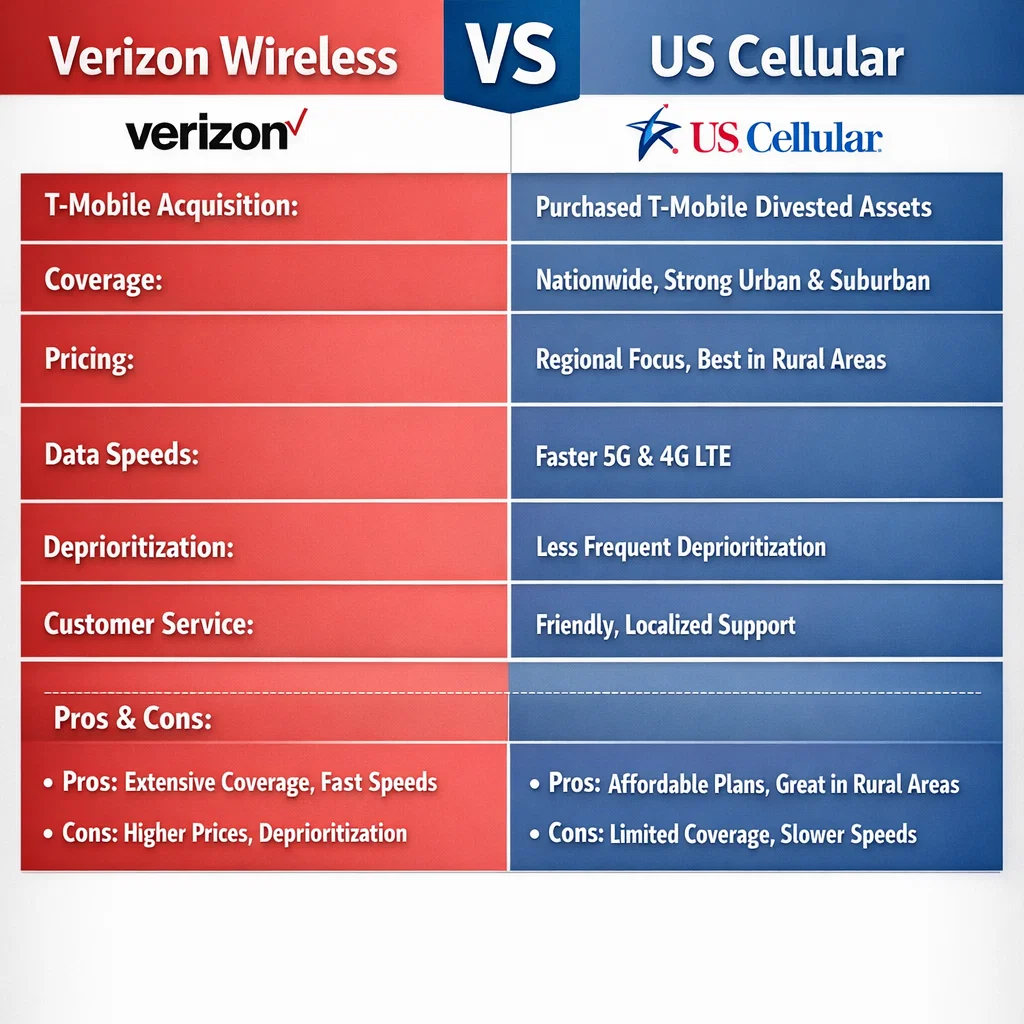
| Feature | Verizon Wireless | US Cellular |
| Best For | Travelers, urban dwellers, and power users who need data everywhere. | Rural residents in specific “home” regions (WI, IA, NE, ME, etc.). |
| Coverage Strategy | National Dominance. Native towers almost everywhere in the USA. | Regional Focus. Excellent local towers, roaming on AT&T/T-Mobile elsewhere. |
| Price (4 Lines) | ~$30 – $50 per line (plus taxes/fees). | ~$30 – $50 per line (taxes/fees usually included). |
| 5G Speed | Fast. Their “Ultra Wideband” (C-Band) is incredibly fast in cities. | Moderate. Reliable mid-band in their regions, but slower peak speeds. |
| The “Catch” | Perks are $10/mo add-ons (Disney, Netflix, etc.). | The company is being sold to T-Mobile (expect changes by 2026/2027). |
| Winner? | Verizon for 90% of people. | US Cellular only if Verizon has a dead zone at your specific address. |
The Big Thing: The T-Mobile Acquisition
Before we talk about Verizon vs US Cellular, we have to talk about the news that changed everything.
T-Mobile is acquiring US Cellular’s wireless operations.
This is critical information that most other comparison blogs are ignoring. In mid-2024, it was announced that T-Mobile is buying US Cellular’s customers and about 30% of their spectrum.
What does this mean for you right now?
If you sign up for UScellular today, you are effectively signing up to become a future T-Mobile customer.
- The Good News: US Cellular customers are already getting access to T-Mobile’s 5G network in areas where US Cellular has gaps. This has massively improved their “roaming” experience.
- The Bad News: The “US Cellular” brand as you know it will eventually fade away. The billing systems and plans will merge.
Why does this matter for the comparison?
When you compare Verizon Wireless vs US Cellular, you are really comparing “Verizon vs. The Future T-Mobile Network.” If you hate T-Mobile for some reason, switching to US Cellular is a bad move, because that is where you will end up. If you like T-Mobile’s network but live in a rural spot where only US Cellular towers exist right now, it’s a safe bet.
Verizon Wireless vs US Cellular Coverage Analysis: The “Map” vs. The “Reality”
When people search for Verizon vs US Cellular coverage map, they usually see a sea of red (Verizon) and a patchy map of blue (US Cellular). But maps lie. Let’s look at the real-world difference.
1. Verizon Wireless: The “Blanket” Approach
Verizon has spent billions on its network. They hold the most “low-band” spectrum in the country, which is the frequency that travels long distances and through walls.
- Native Coverage: Verizon owns its towers in almost every county in America. You are rarely “roaming.”
- Consistency: Whether you are in New York City or a cornfield in Ohio, your phone usually works.
- 5G Ultra Wideband (UW): This is Verizon’s secret weapon. In cities and suburbs, they use “C-Band” frequencies. This gives you speeds of 300+ Mbps. It is fast enough to replace your home internet.
2. US Cellular: The “Swiss Cheese” Approach
US Cellular is a regional carrier. They own towers in about 21 states.
- The “Native” Zone: In places like rural Wisconsin, Iowa, and parts of North Carolina, US Cellular often has towers where Verizon does not. They focused on the farmers and small towns that the big guys ignored.
- The Roaming Zone: Once you leave their 21-state footprint, your phone switches to “Roaming.” Historically, this was terrible. You would get throttled speeds and dropped calls.
- The Upgrade: Thanks to the T-Mobile deal, roaming is better now. But it is still roaming. You are a “guest” on another network, which means your data might be slower than a native Verizon user standing next to you.
The Verdict on Coverage
If you never leave your home town and you know US Cellular works there, keep it. But if you travel, even just to the next state over, Verizon Wireless is superior. The difference between US Cellular and Verizon Wireless is that Verizon is a landlord; US Cellular is a tenant once you leave the Midwest.
Verizon Wireless vs US Cellular Pricings: UScellular vs Verizon Cost
This is where it gets tricky. Both carriers have moved to “Mix and Match” style plans. Gone are the days of simple 2GB limits. Now, everything is “Unlimited,” but some plans are more unlimited than others.
Let’s break down the US Cellular vs Verizon prices for a family of 4 (with AutoPay).
Verizon Wireless Plans (The “myPlan” Era)
Verizon recently blew up their old pricing model. Now, you pick a base plan, and then you pay extra for perks.
- Unlimited Welcome ($30/line):
- The Catch: No priority data. If the tower is busy, you slow down. No hotspot.
- Best For: Kids or people who just use Wi-Fi.
- Unlimited Plus ($45/line):
- The Good Stuff: 30GB Hotspot. True 5G Ultra Wideband speeds.
- Priority: You get “Premium Data,” meaning Verizon won’t slow you down during rush hour.
- Unlimited Ultimate ($55/line):
- The Flex: 60GB Hotspot. International data included.
The “Perk” System: Verizon charges $10/month for “perks” like the Disney Bundle, Netflix/Max, or 100GB extra hotspot. This is great if you use them, but expensive if you don’t.
US Cellular Plans (The “Even Better” Era)
US Cellular tries to undercut the big guys, but often their prices are surprisingly similar.
- Unlimited Basic ($30/line):
- The Catch: SD streaming (480p). Data can be slowed anytime.
- Unlimited Everyday ($40/line):
- The Good Stuff: 25GB Hotspot. HD Streaming.
- Priority: 50GB of “Priority Data.”
- Unlimited Even Better ($50/line):
- The Flex: 50GB Hotspot. 4K Streaming. Unlimited Priority Data.
The “Hidden” Fees Comparison
Here is a major Us cellular vs verizon pros and cons point: Taxes and Fees.
- Verizon: They are notorious for “Admin Fees.” Expect to pay an extra $5–$7 per line in taxes and fees on top of the advertised price.
- US Cellular: Many of their newer promo plans include taxes and fees, similar to T-Mobile. This can save a family of four about $20/month.
Winner on Price: UScellular is slightly cheaper effectively, especially if you avoid the top-tier plan. However, Verizon’s “Unlimited Welcome” is very aggressive if you don’t need a hotspot.
Verizon Wireless vs US Cellular Data Speeds and “Deprioritization”
We used the term “Priority Data” above. Let’s explain that, because it is the biggest complaint people have with Verizon Wireless vs UScellular.
What is Deprioritization?
Imagine the cell tower is a highway.
- Priority Data means you are in the Fast Lane. Even if there is traffic, you move.
- Deprioritized Data means you are in the slow lane. If the highway is empty, you go fast. If the highway is full (rush hour, concert, sporting event), you stop moving.
Verizon’s Approach:
On their cheap “Welcome” plan, you are always in the slow lane. If you are at a football game, your data might be unusable. On “Plus” and “Ultimate,” you are VIP.
US Cellular’s Approach:
On “Basic,” you are in the slow lane. On “Everyday,” you get 50GB of Fast Lane access, then you are bumped to the slow lane.
The Reality Check:
In rural areas (US Cellular’s turf), congestion isn’t usually a problem. There aren’t enough people to clog the tower. So, “Deprioritization” matters less.
In cities (Verizon’s turf), congestion is huge. If you buy the cheap Verizon plan in a big city, you will notice slow speeds.
Phone Compatibility and the “Whitelist”
This is a technical difference between UScellular and Verizon that drives people crazy.
Verizon is very open. If you have an unlocked iPhone, Samsung, or Pixel from the last 5 years, you can pop in a Verizon SIM card and it will work. They use standard LTE and 5G bands.
US Cellular has historically been very strict. They used to use a specific CDMA frequency that required specific radios. While they have moved to LTE/5G, they still maintain a “whitelist” of approved devices.
- If you buy a weird budget phone from Amazon (like a OnePlus or a Sony), it might not work on US Cellular.
- If you bring an old AT&T phone, it might lack the specific “Band 71” or “Band 12” that US Cellular relies on for rural coverage.
Pro Tip: If you switch to US Cellular, check your IMEI on their website first. Do not assume your phone will work just because it is “unlocked.”
Verizon vs US Cellular Customer Service: Local vs. Corporate
This is where the US cellular vs verizon wireless pros and cons list flips.
Verizon Wireless is a massive corporation. Their customer service is largely automated or outsourced. Getting a human on the phone can take 20 minutes. Their app is slick, but if you have a complex billing issue, you are often just a number in a database.
US Cellular built its brand on being “The Friendly Neighbor.”
- Local Stores: In small towns, the US Cellular store is often a community staple. The staff tends to live in the town. They know exactly which hill has a dead zone.
- Support: Generally, users report shorter wait times and friendlier agents with US Cellular.
However, with the T-Mobile acquisition looming, there is a fear that this “small town charm” will disappear as store policies align with the corporate giant. But for now, in 2026, US Cellular still wins on human connection.
Verizon vs US Cellular Pros and Cons
Let’s summarize the battle of Verizon Wireless vs UScellular.
Verizon Wireless
Pros:
- Massive Coverage: The best nationwide network, hands down.
- Speed: 5G Ultra Wideband is incredibly fast (up to 10x faster than LTE).
- Phone Choice: Almost any phone works on their network.
- Perks: Access to Disney+, Hulu, ESPN+, Apple Music (for a fee).
Cons:
- Pricey: Fees add up. The best plans are expensive ($55+/line).
- Congestion: The entry-level plan can be frustratingly slow in cities.
- Customer Service: Can feel impersonal and hard to navigate.
US Cellular
Pros:
- Rural Reliability: Works in valleys and farm roads where others fail.
- Customer Service: Historically better, more local support.
- Price Transparency: Taxes and fees often included.
- T-Mobile Roaming: Now backed by the T-Mobile network for better traveling coverage.
Cons:
- Uncertain Future: The brand is disappearing into T-Mobile.
- Slower Speeds: Their mid-band 5G isn’t as widespread or fast as Verizon’s.
- Device Limits: Picky about which unlocked phones they allow.
Final Decision: Which Should You Choose?
The decision between US Cellular or Verizon Wireless comes down to your ZIP code and your patience for change.
Choose Verizon Wireless If:
- You Travel: If you leave your home state more than twice a year, Verizon’s consistent national network is worth the extra money.
- You Want Speed: If you stream 4K video, game on your phone, or tether your laptop for work, Verizon’s 5G UW is superior.
- You Want Stability: You don’t want to deal with your carrier getting bought out and your plan changing in two years.
Choose US Cellular If:
- You Live in a “USCC Stronghold”: If you are in rural Iowa or Wisconsin and your neighbors say “Verizon drops calls here,” listen to them. Signal physics beats marketing.
- You Want to Save ~$20/Month: For a family of four, the tax-inclusive pricing adds up.
- You Don’t Mind the T-Mobile Merge: If you are okay with eventually becoming a T-Mobile customer, it’s a fine place to park your number.
In the end, Verizon Wireless is the safer bet for 90% of Americans. But for that specific 10% in rural America, US Cellular (and soon T-Mobile) remains a vital lifeline.
Check the Verizon vs US Cellular coverage map for your specific street address before you buy. That is the only test that truly matters.
Frequently Asked Questions
1. Is US Cellular being bought by T-Mobile?
Yes. T-Mobile has agreed to buy US Cellular’s wireless operations and about 30% of their spectrum. This means US Cellular customers will eventually transition to the T-Mobile network. However, US Cellular is keeping their cell towers, so the physical infrastructure in rural areas will remain.
2. Can I use a Verizon phone on US Cellular?
Maybe. Most modern Verizon phones (iPhone 12 and newer, Samsung S21 and newer) are unlocked after 60 days and have the hardware to work on US Cellular. However, US Cellular has a strict “whitelist.” You must enter your device’s IMEI number on the US Cellular website to confirm compatibility before switching.
3. Does Verizon roam on US Cellular towers?
Yes, in specific areas. Through the “LTE in Rural America” (LRA) program, Verizon actually pays US Cellular to let Verizon customers use US Cellular towers in deep rural pockets. If you have Verizon and see “Extended Network” on your phone, you might actually be using a US Cellular tower.
4. Why is my Verizon data so slow compared to US Cellular?
If you are on the “Unlimited Welcome” Verizon plan, your data is “deprioritized.” This means during busy times, Verizon slows you down to let “Unlimited Plus” customers go first. US Cellular also does this on their basic plans, but rural towers are less congested, so you might notice the slowdown less often on US Cellular.
5. Which carrier has better perks, US Cellular or Verizon?
Verizon has “better” premium perks like the Disney Bundle, Netflix, and Apple Music, but you have to pay $10/month for them. US Cellular (now integrating with T-Mobile benefits) offers perks like travel discounts and dining rewards that are often included for free, but they lack the heavy-hitting streaming bundles of Verizon.
6. Who has better 5G, Verizon or US Cellular?
Verizon has the superior 5G network. Their “5G Ultra Wideband” covers over 200 million people and offers speeds over 300 Mbps. US Cellular has 5G, but it is mostly “low-band” 5G, which is only slightly faster than 4G LTE. US Cellular is rolling out faster mid-band 5G, but it is years behind Verizon’s deployment.
This guide to Verizon Wireless vs US Cellular was updated for the 2026 market landscape. Prices and plan details are subject to change by the carriers.