
In 2026, the cell phone market has shifted from “bigger is better” to “smarter is better.” For many, the choice comes down to a heavyweight champion and a value-focused challenger: Verizon vs Consumer Cellular.
One is a global giant known for building the network everyone else uses, while the other is a specialized carrier that has mastered the art of simplicity. If you are trying to decide between the two, this guide ignores the marketing fluff and looks at the real-world differences in coverage, cost, and perks for 2026.
Verizon vs Consumer Cellular: Big Tech vs. Smart Value
Before checking your bars, it helps to understand who these companies are.
Verizon is a primary carrier. They own the towers, the fiber-optic wires, and the 5G technology. They are built for users who want “everything”—international roaming, high-speed 5G Ultra Wideband, and bundles that include Disney+ or Netflix.
Consumer Cellular is an MVNO (Mobile Virtual Network Operator). They don’t own towers. Instead, they buy space on the nationwide AT&T network. They focus on a “no-frills” experience, targeting users who want a reliable phone without a complex bill or a long-term commitment.
Network DNA: Who Actually Powers Your Signal?
The biggest myth to bust is that Consumer Cellular uses Verizon towers. It doesn’t.
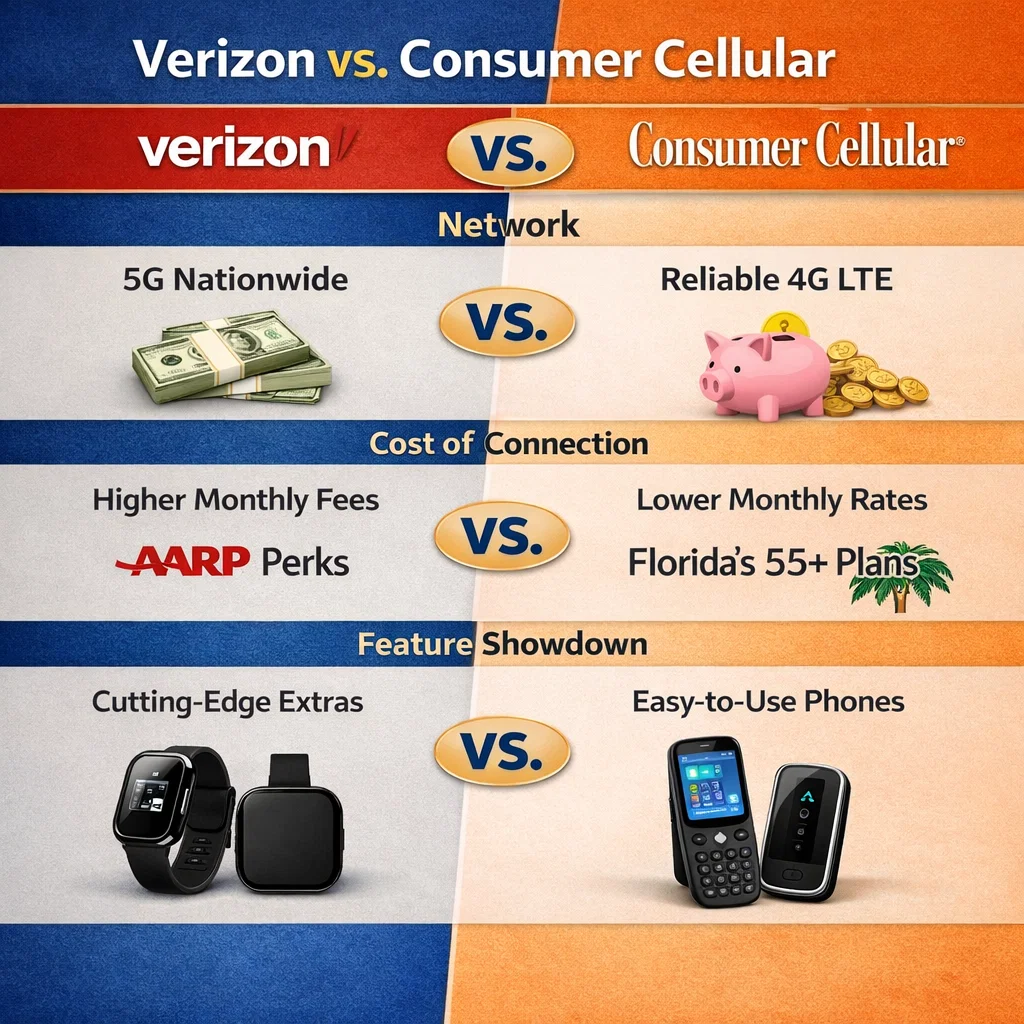
- The Verizon Network: In 2026, Verizon is the gold standard for rural reliability. If you live in a remote area or travel cross-country, Verizon’s signal is often the only one that reaches.
- The Consumer Cellular Network (via AT&T): Consumer Cellular uses the AT&T network. This network is world-class in cities and suburbs, covering 99% of the population. However, it may occasionally have spots in deep rural areas where Verizon still holds the lead.
Decision Factor: If you live in a city or town, both will be excellent. If you live in the deep country, check the Verizon coverage map vs. the AT&T map for your specific zip code before switching.
The Cost of Connection: Analyzing the Monthly Bill
In 2026, the price gap between these two can be hundreds of dollars a year.
| Plan Feature | Verizon (Postpaid) | Consumer Cellular |
| Starting Price | ~$65 (1 Line) | $20 (1GB/Line) |
| Unlimited Data | ~$65 – $90 | $50 (Single Line) |
| AARP Member Offer | None | 2 Lines for $55 |
| Taxes & Fees | Added at the end | Added at the end |
Verizon is significantly more expensive for a single line. However, they become more competitive if you have four or more lines, often dropping the price to around $25–$30 per line on their Unlimited Welcome plan.
Consumer Cellular is the clear winner for individuals and couples. Their 2 lines for $55 deal (for AARP members) is one of the most popular plans in the country for 2026.
Senior-Specific Battle: AARP Perks vs. Florida’s 55+
Both carriers want to win over older adults, but they use different strategies.
The Consumer Cellular Advantage (AARP)
Consumer Cellular is the exclusive wireless partner of AARP. If you are a member, you get:
- 5% off your monthly service.
- 30% off accessories like cases and chargers.
- 45-day risk-free guarantee to try the service.
The Verizon Florida Strategy
Verizon doesn’t have a nationwide senior discount. However, they offer a specialized 55+ plan exclusively for residents of Florida. If you live in the Sunshine State, you can get a single line of unlimited data for a much lower rate than their standard plans.
Feature Showdown: “Extras” vs. “Essentials”
Verizon “Extras”
Verizon is built for the “Power User.” Their plans allow you to add “perks” for about $10/month each, such as:
- Disney Bundle (Disney+, Hulu, ESPN+).
- Apple One or Walmart+ memberships.
- Massive Hotspot Data: Up to 60GB for working on your laptop.
Consumer Cellular “Essentials”
Consumer Cellular skips the TV bundles to keep your bill low. Instead, they focus on:
- US-Based Support: You talk to people in America who are trained to be patient and helpful.
- Target In-Store Support: You can visit a Target store to get help with your phone in person.
- Flexible Data: If you use more data than your plan allows, they automatically bump you to the next tier instead of cutting you off or charging “overage fees.”
Frequently Asked Questions
1. Does Consumer Cellular use Verizon towers in 2026?
No. Consumer Cellular uses the AT&T network. If you want a budget carrier that specifically uses Verizon towers, you should look at Visible or Straight Talk.
2. Can I keep my number if I switch?
Yes. Both carriers allow you to “port” your number. Your service remains active with your old carrier until the new SIM card is activated.
3. Does Verizon have better 5G than Consumer Cellular?
Verizon’s 5G Ultra Wideband is often faster in major cities. However, for everyday things like Facebook, email, and YouTube, Consumer Cellular’s 5G (via AT&T) is more than fast enough.
4. Which carrier has better customer service?
Consumer Cellular consistently wins awards from J.D. Power for its customer service. Their team is specialized in helping people who may not be “tech experts.” Verizon is a giant company, and their support can sometimes involve longer wait times or automated menus.
5. Can I use my own phone?
Yes! As long as your phone is “unlocked,” it will work on either carrier. You simply swap the SIM card.
6. Is there a contract?
Neither company requires a long-term service contract in 2026. However, if you buy a new phone from them on a payment plan, you must finish those payments if you decide to leave.
Final Verdict: Which One Wins?
The winner of the Verizon vs Consumer Cellular debate depends on your zip code and your lifestyle.
Choose Consumer Cellular if:
- You want the lowest possible price for 1 or 2 lines.
- You are an AARP member.
- You value friendly, human customer service.
- You live in a city or suburb where AT&T has a strong signal.
Choose Verizon if:
- You live in a rural area where other carriers have no signal.
- You want to bundle your phone with Disney+, Netflix, or Hulu.
- You have a large family (4+ lines) and can get the multi-line discount.
- You live in Florida and qualify for their exclusive 55+ plan.