
In 2026, the budget wireless market is more crowded than a Saturday morning at the grocery store. Two names that always come up are TracFone and Consumer Cellular.
While they both aim to save you money, they are built for two very different types of users. One is the king of “pay only for what you need,” while the other is a premium service for a bargain price. In this guide, we’ll look at TracFone vs Consumer Cellular to see which one deserves your business this year.
The Core Difference: Prepaid vs. Postpaid
To understand these two, you first have to look at how you pay for them.
- TracFone (The Prepaid King): TracFone is a prepaid carrier. You buy “airtime cards” or service plans in 30-day, 60-day, or even 365-day blocks. It’s perfect for people who want to pay once and forget about it for a while.
- Consumer Cellular (The Postpaid Pro): This is a traditional monthly service. You use your phone for the month and get a bill at the end. There are no contracts, but it feels more like a “standard” phone company experience.
The Network Battle: Who Has Better Signal?
In 2026, both carriers are using top-tier towers, but they don’t use the same ones.
The TracFone Network (Verizon)
TracFone is now part of the Verizon family. While they used to use all three networks, most new customers in 2026 are placed on Verizon’s towers.
- Rural Strength: Because it uses Verizon, TracFone is often the better choice if you live in the “middle of nowhere.”
- 5G Access: You get access to Verizon’s nationwide 5G, though you might not get the ultra-fast “mmWave” speeds found in big cities.
The Consumer Cellular Network (AT&T)
Consumer Cellular primarily runs on the AT&T network.
- Nationwide Reach: AT&T covers 99% of Americans. It is excellent in suburbs and cities.
- 5G+ Support: Consumer Cellular users now have access to AT&T’s mid-band 5G+ signal, which offers a great balance of speed and distance.
Plan Comparison: Comparing the Costs
| Feature | TracFone (Smartphone Plans) | Consumer Cellular |
| Starting Price | $15 (1GB Data) | $20 (1GB Data) |
| Middle Plan | $25 (4GB Data) | $35 (10GB Data) |
| Unlimited Data | $45 (TracFone Freedom) | $50 |
| Senior Discount | None | 5% AARP Discount |
| Carryover Data | Yes (Unlimited) | No |
The “Carryover” Advantage
TracFone’s biggest secret weapon is Carryover Data. If you don’t use all your minutes or data this month, they stay in your account forever as long as your service is active. Consumer Cellular follows a “use it or lose it” model.
Customer Service: Human Support vs. Digital Convenience
This is where the two carriers truly diverge in 2026.
- Consumer Cellular: They are the undisputed champions of service. Their support is 100% U.S.-based. If you have a problem, you can also walk into a Target store and talk to a human in person. They are designed specifically for people who aren’t “tech experts.”
- TracFone: Their service is mostly digital or handled through a large call center. While they have improved their app and website, it can sometimes be harder to get a specialized “human” touch compared to Consumer Cellular.
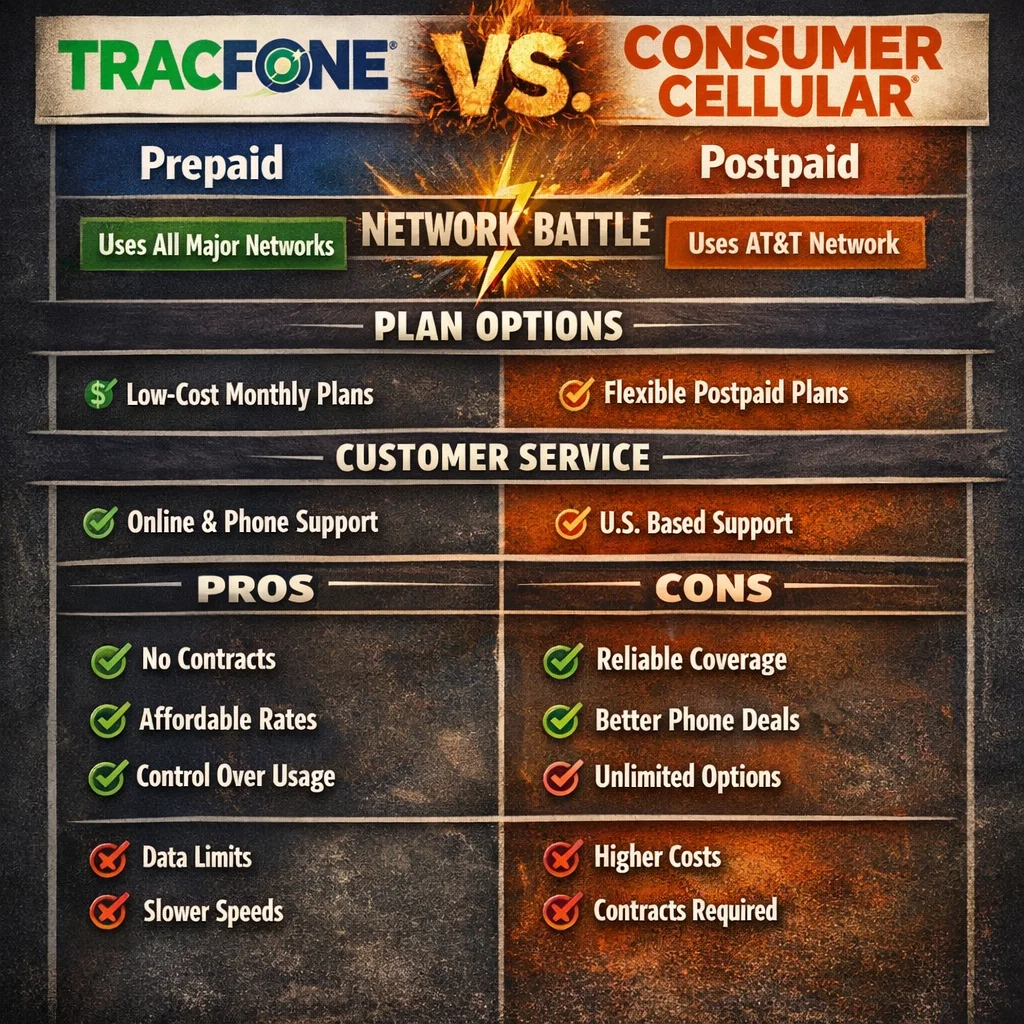
TracFone vs Consumer Cellular Pros and Cons
TracFone Pros
- Ultra-Low Price: Plans start at just $9.99 for basic flip phones.
- Verizon Towers: Great for rural areas.
- Unused Data Stays: You never pay for data you don’t use.
- Annual Options: You can pay for a full year for around $125–$150.
TracFone Cons
- No Multi-Line Discounts: Every line is its own plan.
- No AARP Discount: You pay the same as everyone else.
- Complex Refills: You have to remember to “top up” your account.
Consumer Cellular Pros
- Best-in-Class Support: Friendly and easy to reach.
- AARP Perks: Excellent discounts for members.
- Auto-Refill: No worrying about “buying minutes.”
- Target Partnerships: Get help where you already shop.
Consumer Cellular Cons
- Higher Starting Price: $20 is the minimum.
- No Carryover: Unused data disappears at the end of the month.
Frequently Asked Questions
1. Does TracFone use the same towers as Consumer Cellular?
No. In 2026, TracFone is powered by Verizon, while Consumer Cellular is powered by AT&T.
2. Is TracFone better for seniors than Consumer Cellular?
It depends. Consumer Cellular is better for seniors who want high-quality support and AARP deals. TracFone is better for seniors who barely use their phones and want a $10/month basic plan.
3. Can I keep my number if I switch?
Yes! Both carriers allow you to “port” your number. This means you keep your current phone number.
4. Does TracFone have unlimited data in 2026?
Yes! They recently launched the TracFone Freedom plan for $45/month, which includes unlimited data (though speeds may slow after a certain point).
5. Can I use my old phone?
Yes. Both companies have “Bring Your Own Phone” (BYOP) programs. Just ensure your phone is “unlocked” from your previous company.
Final Verdict: Which One Should You Pick?
The TracFone vs Consumer Cellular winner depends on your phone habits.
- Choose TracFone if: You are a “light user.” If you only use your phone for emergencies or the occasional text, TracFone’s low prices and carryover minutes will save you a fortune.
- Choose Consumer Cellular if: You want a traditional phone experience with better service. If you are an AARP member and want a company that is easy to deal with, Consumer Cellular is the gold standard for 2026.
Switching is easier than ever, and most phones now use eSIM, allowing you to switch in minutes. Why keep paying “big carrier” prices?