
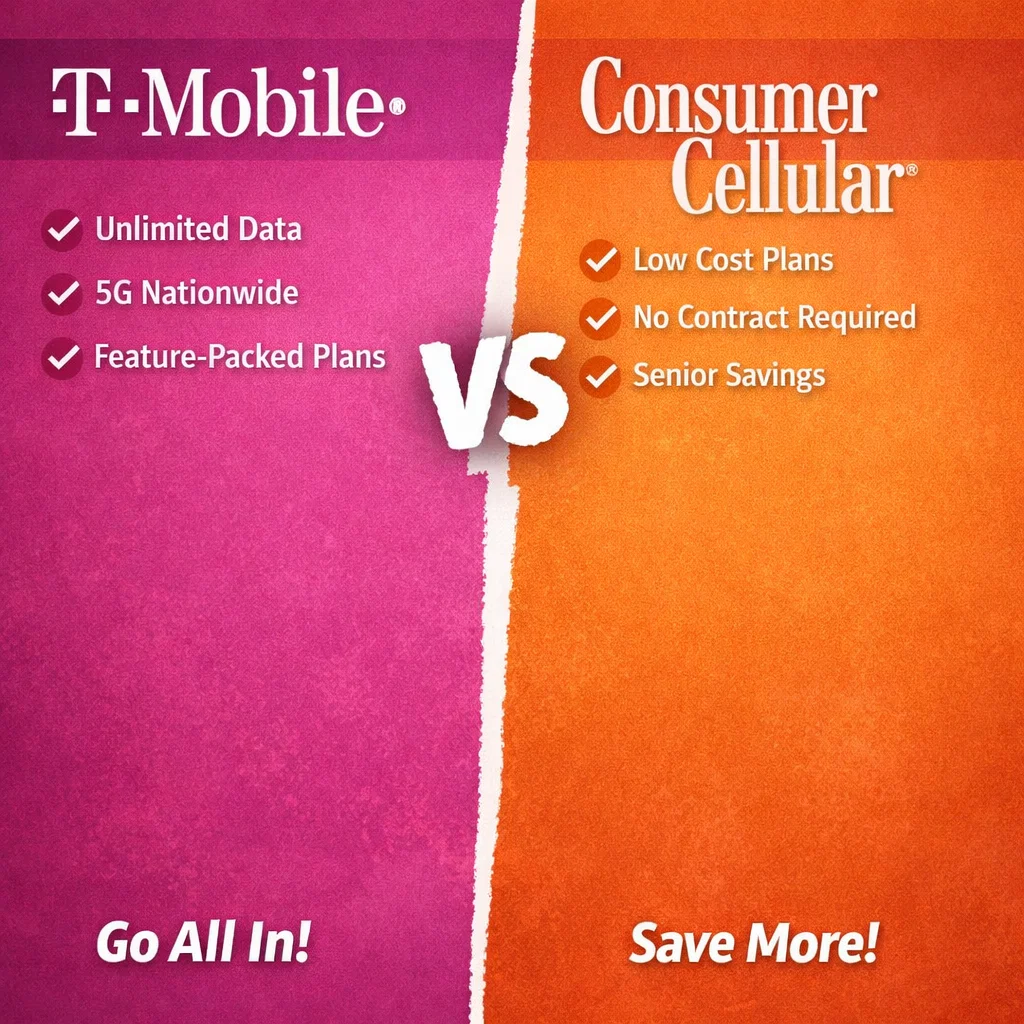
In 2026, the cell phone landscape is no longer about choosing between “the big guys” and “the cheap guys.” It is about choosing the right tool for your specific lifestyle. On one side, we have T-Mobile, the massive “Un-carrier” that has rebranded itself as a high-tech powerhouse. On the other, we have Consumer Cellular, the customer-service champion that has mastered the art of simplicity.
This isn’t just a comparison of signal bars. It’s a comparison of philosophies. One carrier wants to give you the fastest 5G and free Netflix; the other wants to ensure you never have to argue with a robot to get a human on the phone. Let’s dive into the T-Mobile vs Consumer Cellular battle for 2026.
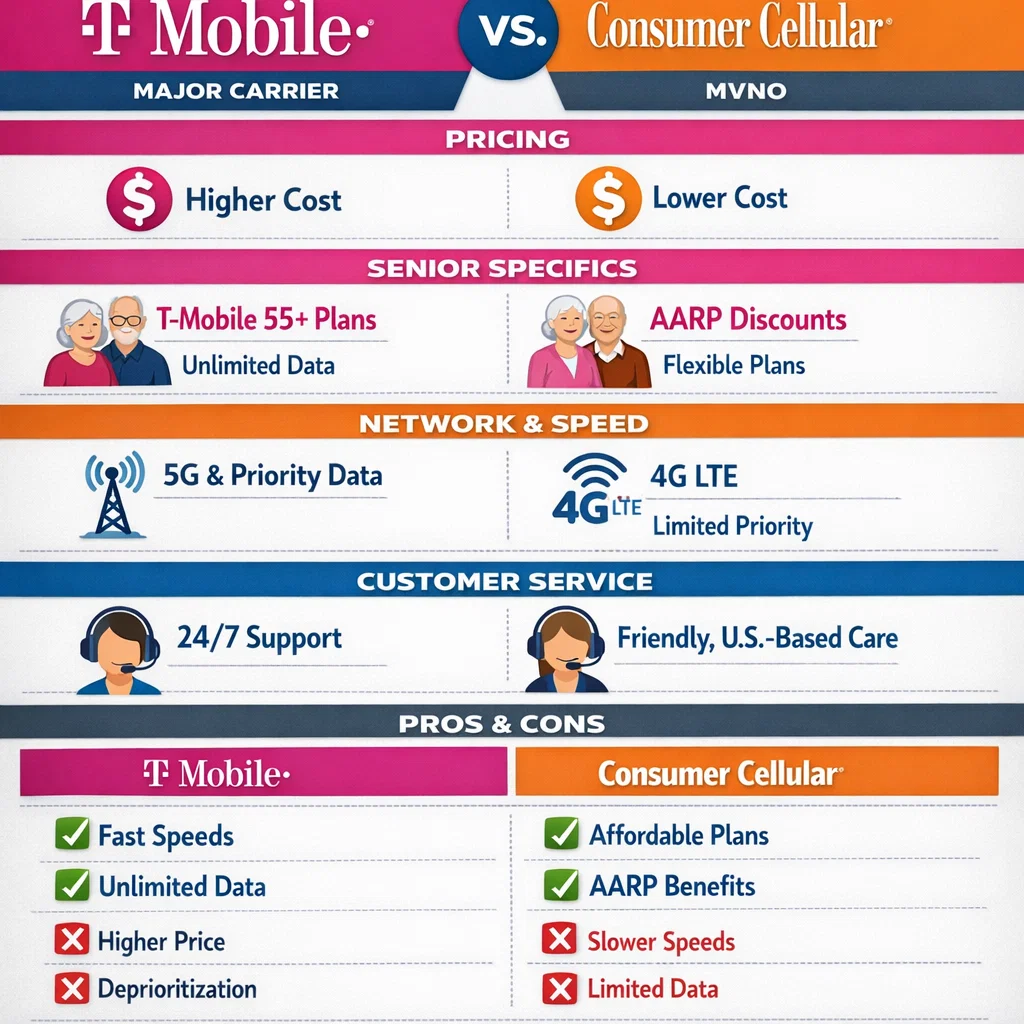
TMobile vs Consumer Cellular: Major Carrier vs. MVNO
To understand this matchup, you have to look under the hood.
T-Mobile is a “Major Carrier.” They own their towers, their fiber-optic wires, and the specialized 5G technology that powers your phone. In 2026, they are the leaders in 5G speed and are even launching T-Satellite, a service that keeps you connected to everyday apps even when you’re completely off-the-grid.
Consumer Cellular is a “Mobile Virtual Network Operator” (MVNO). They don’t build towers. Instead, they partner with the giants. In 2026, they primarily use the AT&T and T-Mobile networks to provide coverage. When you use Consumer Cellular, you are using the same “pipes” as the big guys, but you are paying a different price for the experience.
2026 Pricing: The “Better Value” vs. The “Simple Savings”
The monthly bill is the biggest reason people switch. Here is how the 2026 plans stack up for a single line and a family.
T-Mobile: The “High-End” Value
T-Mobile has moved away from “budget” pricing for single lines. Their newest flagship plan, Better Value, starts around $105 for a single line (though it drops to $46/line for three lines).
- The “Experience” Plans: These are pricey but include everything: unlimited high-speed data, huge hotspot buckets (up to 250GB), and satellite connectivity.
- Connect by T-Mobile: If you want T-Mobile but on a budget, they have “Connect” plans starting at $15/month for 5GB of data.
Consumer Cellular: The “Mid-Range” King
Consumer Cellular keeps it incredibly simple. They don’t have “hidden” perks; they just have clear prices.
- 1GB Plan: $20/month.
- 10GB Plan: $35/month.
- Unlimited Plan: Starts at $50/month.
The Verdict on Price: If you are one person who doesn’t use much data, Consumer Cellular wins easily. If you have a family of four and want free streaming services and new phones, T-Mobile‘s family bundles are actually a better deal.
Senior Specifics: T-Mobile 55+ vs. Consumer Cellular AARP
Both carriers are fighting for the 50+ demographic. This is where the competition is the most fierce in 2026.
Consumer Cellular: The AARP Gold Standard
They are the only carrier that is the official partner of AARP. If you are a member, you get:
- Two lines of unlimited data for $55.
- 5% off your monthly service.
- 30% off accessories like chargers and cases.
- A 45-day risk-free trial. ### T-Mobile: The 55+ Experience T-Mobile offers the Essentials Choice 55 and the Experience Beyond 55+ plans.
- Essentials Choice 55: ~$45 for a single line or ~$60 for two lines.
- Experience Beyond: More expensive (~$70/line) but includes Apple TV+, Netflix, and the ability to upgrade your phone every single year.
The Comparison: If you want a cheap, reliable plan and you’re an AARP member, Consumer Cellular is unbeatable. If you are a senior who travels and loves watching movies on your phone, T-Mobile 55+ is the premium choice.
Network & Speed: 5G vs. Priority
In 2026, everyone has 5G, but not all 5G is created equal.
- T-Mobile: Since they own the network, their customers get the highest priority. This means that at a crowded concert or a busy airport, T-Mobile users keep their high speeds while others might slow down.
- Consumer Cellular: They use the same towers, but they are “deprioritized.” If the tower gets too busy, T-Mobile will slow down Consumer Cellular users to keep their own customers fast.
The T-Satellite Edge: A major 2026 update for T-Mobile is satellite data. If you are hiking in a canyon with no towers, you can still send texts and use maps via satellite. Consumer Cellular does not yet offer this feature.
Customer Service: The Human Touch
This is where the two carriers live on different planets.
Consumer Cellular is the undisputed champion of customer care. Their support is 100% U.S.-based. When you call, a person answers. They are trained to be patient and helpful. Plus, you can walk into any Target store and get help with your phone in person.
T-Mobile has “Maganta Status.” They have great support through their app and stores, but it is a large corporate environment. You might deal with a chatbot first, and their stores can be very busy with people buying new iPhones.
Pros and Cons: A Quick Look
T-Mobile Pros
- The Fastest 5G: Consistently wins speed tests in 2026.
- Streaming Perks: Free Netflix, Apple TV+, and Hulu on many plans.
- International Travel: Excellent data roaming in over 215 countries.
- T-Satellite: Connectivity even without cell towers.
T-Mobile Cons
- Price: Their flagship plans are the most expensive in the industry.
- Complex Bills: It can be hard to track all the “perks” and credits.
Consumer Cellular Pros
- Best Support: Friendly, human, and easy to reach.
- Simplicity: No contracts, no complex “bundles” you don’t need.
- AARP Deals: The best 2-line unlimited deal for seniors.
- In-Person Help: Available at Target stores nationwide.
Consumer Cellular Cons
- Slower Speeds: May slow down in very crowded areas.
- Fewer Perks: No free Netflix or “T-Mobile Tuesdays” prizes.
Frequently Asked Questions (FAQ)
1. Does Consumer Cellular use T-Mobile towers?
Yes! In 2026, Consumer Cellular uses both AT&T and T-Mobile towers. They generally place you on the network that has the best signal at your home address.
2. Is T-Mobile better for seniors than Consumer Cellular?
It depends on the senior. Consumer Cellular is better for those who want a simple $20–$30 bill and great support. T-Mobile is better for seniors who travel, use a lot of data, and want the latest tech.
3. Can I keep my number if I switch?
Yes. Both carriers allow you to “port” your number. Just don’t cancel your old service until the new one is active.
4. Does Consumer Cellular have 5G?
Yes. All Consumer Cellular plans include full access to 5G. In 2026, they also have access to 5G+ (mid-band) for faster speeds in cities.
5. What is the T-Mobile “5-Year Price Guarantee”?
In 2026, T-Mobile guarantees that your monthly price for talk, text, and data won’t change for five years on their newest plans.
6. Do I need a credit check?
T-Mobile postpaid plans usually require a credit check. Consumer Cellular also performs a soft credit check, but they are often more flexible for those with limited credit history.
Final Verdict: Which One Should You Pick?
The T-Mobile vs Consumer Cellular winner depends on your “Mobile Personality.”
Choose T-Mobile if:
- You have a family (3+ lines) and want the best price per line.
- You are a “Power User” who watches movies and plays games on 5G.
- You travel internationally or go “off-the-grid” frequently.
- You want a brand-new phone every year through their upgrade programs.
Choose Consumer Cellular if:
- You are an individual or a couple looking to save $500+ a year.
- You are an AARP member.
- You want a simple, honest company that answers the phone when you call.
- You live in a city or town where AT&T or T-Mobile signal is strong and you don’t need “satellite” extras.
In 2026, there is no reason to overpay for your phone. Both of these carriers are excellent—it just comes down to whether you want the “Ferrari” of networks (T-Mobile) or the “Reliable Sedan” (Consumer Cellular).