
We all want to save money on our phone bills. The big carriers like Verizon, AT&T, and T-Mobile are expensive. You pay a lot every month for data you might not even use.
That is why so many people are looking at “alternative” carriers. These are smaller companies that offer the same service for a lot less money.
Two of the most popular options right now are Straight Talk and Xfinity Mobile.
If you look at them quickly, they seem very similar. They both offer unlimited data. They both promise great coverage. And most importantly, they both promise to cut your phone bill in half.
But if you dig a little deeper, they are actually very different services designed for very different types of people. Choosing the wrong one could lead to slower speeds, frustrating customer service, or hidden costs you didn’t expect.
This guide is going to break down the Straight Talk vs Xfinity Mobile battle completely. We won’t just look at the price tags. We will look at the hidden rules, network speeds, and real-world performance so you can decide which one is actually right for your life.
Straight Talk vs Xfinity Mobile: The Biggest Difference
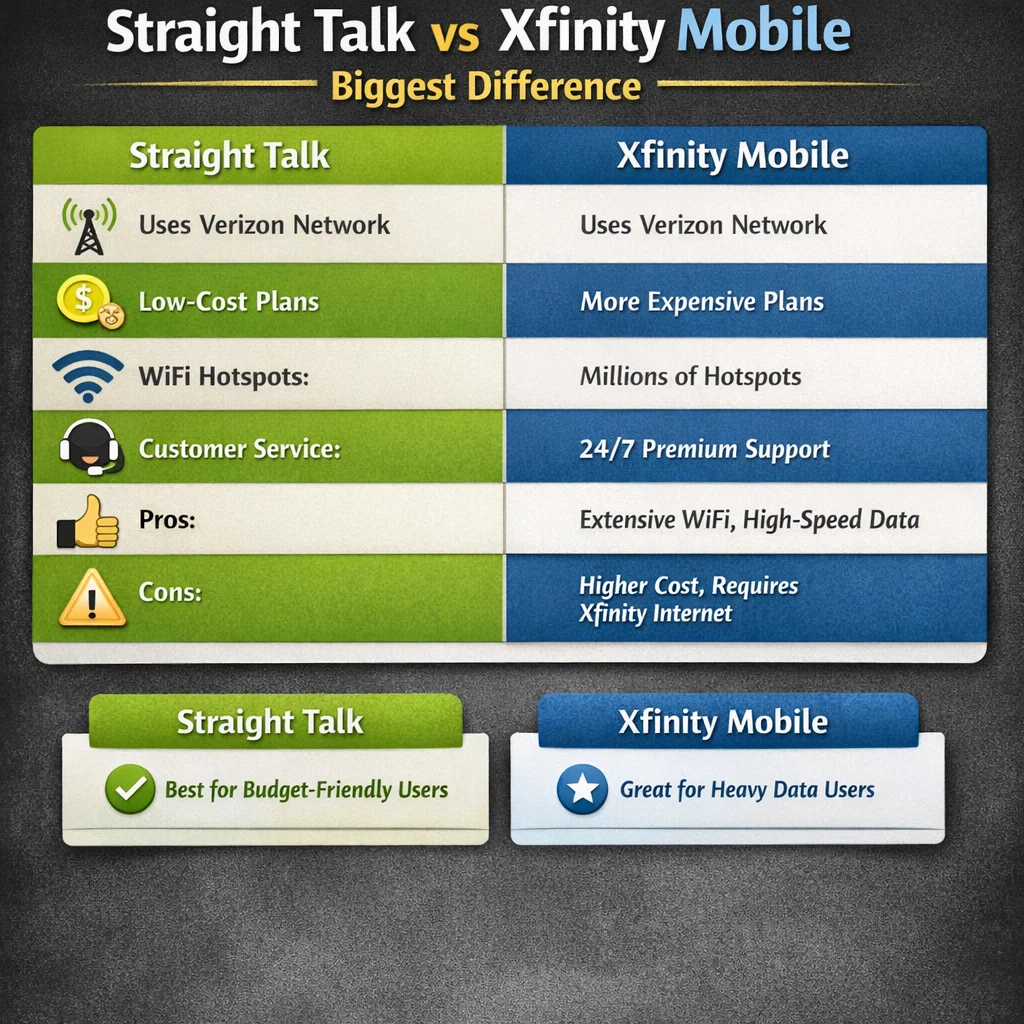
Before we dive into charts and graphs, we need to stop and address the single biggest difference between these two companies.
If you miss this part, nothing else in this article matters.
To sign up for Xfinity Mobile, you almost always need to be an Xfinity Home Internet customer first.
Xfinity Mobile is not really a standalone product. It’s designed as a special perk or bundle for people who already pay Comcast/Xfinity for their home Wi-Fi.
If you live in an area where Xfinity internet isn’t available, or if you just prefer a different internet provider, you generally cannot get Xfinity Mobile. (Note: Sometimes they let you keep the mobile service if you cancel their internet later, but they usually add an extra $25 fee per line per month, which ruins the savings).
Straight Talk is different. It is a true prepaid carrier. You don’t need any other services. You don’t need a credit check. You just buy a phone or a SIM card, pick a plan, and you are good to go. You can buy it online or walk into a Walmart and grab a card off the rack.
The takeaway: If you do not have Xfinity internet at home right now, Straight Talk is your only option between these two. If you do have Xfinity internet, keep reading, because Xfinity Mobile might offer you an incredible deal.
Straight Talk vs Xfinity Mobile Comparison Table
If you are in a hurry, here is a quick snapshot of how Xfinity Mobile vs Straight Talk stacks up.
| Feature | Straight Talk | Xfinity Mobile |
| Carrier Type | Prepaid (No contract) | Postpaid (Requires Xfinity Internet) |
| Network Used | Verizon | Verizon |
| Cheapest Plan | $35/mo (10GB) | By-the-Gig ($20/mo for 1GB shared) |
| Unlimited Plan | Starts at $45/mo | Starts at $45/mo (cheaper with multiple lines) |
| Family Plans | Multiline discounts available on ultimate plans only | Excellent family sharing options |
| Data Priority | Can be slowed down during busy times | Higher priority data on expensive plans |
| Extra Perks | Walmart convenience, Rewards program | Access to millions of Xfinity WiFi hotspots |
Straight Talk vs Xfinity Mobile: The Network Game
When you buy a phone plan from a smaller company, you aren’t actually using their towers. They don’t have any. They rent space on towers owned by the “Big Three” carriers.
This is great news for you. It means you get big-carrier coverage for a small-carrier price.
So, which networks do Straight Talk and Xfinity Mobile use?
This used to be complicated. Straight Talk used to sell SIM cards that worked on AT&T, T-Mobile, or Verizon. You had to choose.
That changed recently. Straight Talk was bought by Verizon. Now, for nearly all new customers, Straight Talk uses the Verizon network.
Xfinity Mobile also uses the Verizon network.
This means that on a basic level, your coverage map will look exactly the same with both carriers. If your friend has Verizon and gets a signal at your house, you will likely get a signal with Straight Talk or Xfinity too. Both carriers also give you access to Verizon’s super-fast 5G network if you have a compatible phone.
The Secret of “Data Prioritization”
If they both use Verizon, the service must be exactly the same, right?
Not exactly. This is where things get a little tricky. It’s about something called “data prioritization.”
Think of the Verizon network like a giant multi-lane highway.
- People who pay top dollar directly to Verizon for their best postpaid plans are in the express lanes. Their cars (data) always move fast.
- When the highway isn’t busy, everyone moves fast. It doesn’t matter which lane you are in.
- But when traffic gets bad—like at a crowded football game, a concert, or during rush hour in a city—the highway gets jammed.
When that happens, Verizon has to decide whose data gets through first. They prioritize their own high-paying customers. The other cars are shifted into the slow lanes.
Straight Talk customers are usually in those slower lanes. During times of heavy network congestion, your data speeds might suddenly drop. Your video might start buffering, or webpages might load slowly. This is called “deprioritization.”
Xfinity Mobile is a bit different. On their cheapest unlimited plans, you are also in the slow lane. However, Xfinity sells “premium” data options. If you buy their highest-tier unlimited plan, or if you use their “By the Gig” plans, you often get higher priority data. That means when traffic is bad, your phone will still work pretty well, while a Straight Talk user next to you might be struggling.
Who cares about this? If you are a heavy gamer or need lightning-fast speeds 24/7 in crowded cities, Xfinity’s premium data options are better. If you just browse Facebook and check email, you probably won’t notice the difference with Straight Talk.
Straight Talk vs Xfinity Mobile Costs
This is what everyone wants to know. Which one is cheaper?
The answer depends entirely on whether you are just buying a phone for yourself, or if you are buying plans for a whole family.
Straight Talk: Best for Individuals and Simplicity
Straight Talk is simple. You pick a 30-day plan, you pay for it, and it works. There are no surprise overage fees. When your month is up, you buy another card.
Here is a look at their popular smartphone plans (prices usually include a small auto-pay discount):
- Bronze Unlimited ($35): You get 10GB of high-speed data. If you go over 10GB, your speeds slow down to 2G (which is basically unusable for modern internet) for the rest of the month. You also get 5GB of hotspot data to share with a laptop.
- Silver Unlimited ($45): This gives you “unlimited” high-speed data. However, if you use more than 60GB in a month, they might review your account and slow you down. You get 10GB of hotspot data.
- Gold Unlimited ($55): Unlimited high-speed data with a higher review threshold, plus 15GB of hotspot data. They also throw in 100GB of cloud storage.
- Platinum Unlimited ($65): Unlimited data, 20GB of hotspot, and international calling benefits.
The Vibe: Straight Talk is perfect if you just want one line and you want to know exactly what you will pay every month. $45 is $45. It’s easy to manage, especially since you can pick up refill cards when you are grocery shopping at Walmart.
Xfinity Mobile: Best for Families and Flexibility
Xfinity Mobile’s pricing is more complex, but it can be much cheaper if you know how to work the system. They have two main ways to pay.
1. By the Gig (Best for light users)
This is a very unique plan. You pay for a bucket of data that all the lines on your account share.
- 1GB shared = $20/mo
- 3GB shared = $40/mo
- 10GB shared = $65/mo
Every line you add gets unlimited talk and text for free; they just share that data bucket.
Imagine a retired couple who barely uses their phones outside the house because they are always on home Wi-Fi. They could get two phone lines, share the 1GB bucket, and their total bill for two phones would be $20 a month plus taxes. That is unbeatable.
However, if you go over your bucket, they automatically charge you $20 for another GB. It can get expensive fast if you aren’t careful.
2. Unlimited Plans (Best for heavy users)
Like everyone else, Xfinity offers unlimited data. But their prices drop dramatically when you add more people to the plan.
- Unlimited Intro: It gives you unlimited data, but speeds might slow down after you use 30GB in a month. You get unlimited hotspot, but at slow (3G) speeds.
- 1 line: $45/mo
- 2 lines: $30/mo per line ($60 total)
- 4 lines: $30/mo per line ($120 total)
They also have pricier “Plus” and “Premium” unlimited plans that offer more high-speed data before slowing you down, faster hotspot speeds, and better video streaming quality.
The Vibe: Xfinity is built for families who already have Xfinity internet. If you have a family of four, getting four unlimited lines for $120 total on the Verizon network is an amazing deal. Straight Talk would cost you closer to $180 for four similar lines.
The Xfinity “Secret Weapon”: WiFi Hotspots
There is one major feature that Xfinity Mobile has that Straight Talk does not. It can make a huge difference in how much cellular data you actually use.
Because Comcast/Xfinity is a massive internet company, they have millions of Wi-Fi hotspots all over the country. These are in coffee shops, parks, businesses, and even broadcast from residential home routers.
When you have an Xfinity Mobile phone, your phone is programmed to automatically connect to these secure hotspots whenever you are near one.
You don’t have to do anything. You could be walking down the street streaming music, and your phone will switch from the cellular network to a free Xfinity Wi-Fi hotspot without you noticing.
Why is this a big deal?
Every minute you are connected to Wi-Fi is a minute you aren’t using your mobile data allowance. It saves your battery, and it often gives you faster speeds than cellular data in crowded areas.
Straight Talk users have to rely purely on the cellular signal unless they manually connect to public Wi-Fi.
Xfinity Mobile vs Straight Talk Customer Service
This is where the rubber meets the road. It’s great to have a cheap phone bill, but if you have a problem, will anyone help you?
We have to be honest here: neither of these companies is famous for winning customer service awards.
Straight Talk Customer Service
If you look at online forums like Reddit, you will see many complaints about Straight Talk’s customer support. Their call centers are often overseas. Users report that it can be difficult to understand the agents, and the agents often stick to very rigid scripts.
If you have a simple issue, they can fix it. But if you have a complex technical problem, or if you are trying to unlock your phone to move to another carrier later, it can be a very frustrating experience.
The main advantage of Straight Talk’s user experience is Walmart. If you need a new SIM card, a new phone, or just to pay your bill, you can do it in person at a store you probably visit anyway.
Xfinity Mobile Customer Service
Xfinity Mobile support is handled by Comcast. Comcast doesn’t have the best reputation for customer service either.
However, they do have a few advantages over Straight Talk.
- They have physical Xfinity stores. You can walk in and talk to a real human being if you are having major issues.
- Because it’s tied to your home internet account, the support agents can sometimes see a bigger picture of your connectivity issues.
Users generally rate Xfinity Mobile support higher than Straight Talk, but it still isn’t as good as the premium support you get from expensive carriers like T-Mobile or Verizon postpaid.
Buying Phones vs. Bringing Your Own
Both carriers let you bring your own compatible phone (BYOP). If you have an unlocked iPhone or Samsung Galaxy that works on Verizon, you can probably use it with either company.
But what if you need to buy a new phone?
Straight Talk is great for budget-friendly phones. You can walk into Walmart and find racks of phones for under $100 or $200. They work perfectly fine for basic tasks. They also sell newer iPhones and Samsungs, often with options to pay them off over time through third-party financing.
Xfinity Mobile operates more like a major carrier. They want you to buy the newest, most expensive phones. They often run aggressive promotions. For example, they might offer you $800 off a new iPhone 15 if you trade in your old device and sign up for an unlimited plan.
These deals usually require you to stay with Xfinity for 24 months to get the full discount. Straight Talk rarely has those kinds of long-term contract requirements.
Straight Talk vs Xfinity Mobile Pros and Cons
Let’s summarize everything we have learned into a simple list. This will help you weigh the good and the bad.
Straight Talk
Pros:
- No Strings Attached: No contracts, no credit checks, and no requirement to have another service (like home internet).
- Predictable Pricing: Flat-rate monthly cards. Taxes and fees are usually low.
- Walmart Convenience: Easy to buy phones and refill cards while shopping.
- Great Coverage: Runs on the powerful Verizon network.
- Simple for Singles: Great one-line pricing.
Cons:
- Data Deprioritization: Your speeds can slow down significantly in crowded areas.
- Poor Customer Service: Telephone support can be notoriously frustrating.
- Limited Perks: No access to a massive Wi-Fi hotspot network like Xfinity.
- Expensive Family Plans: No real discounts for adding multiple lines on the basic unlimited plans.
Xfinity Mobile
Pros:
- Excellent Family Pricing: The more lines you add to unlimited plans, the cheaper it gets per person.
- Flexible “By the Gig” Options: Incredible value for very light data users or couples.
- Premium Data Options: You can pay for plans that don’t get slowed down as easily in traffic.
- WiFi Hotspots: Automatic connection to millions of hotspots saves data and improves speeds.
- Great Phone Deals: Often has big trade-in offers for the newest flagship phones.
Cons:
- The Eligibility Barrier: You MUST be an Xfinity Internet customer to sign up.
- Tied to Comcast: If you get mad at Comcast internet and cancel it, your mobile bill shoots up.
- Risk of Overage Fees: The “By the Gig” plan can get expensive if you accidentally use too much data.
- Not Truly Prepaid: It’s a postpaid service that requires a credit check.
Frequently Asked Questions (FAQs)
Here are answers to some common questions people ask when comparing these two carriers.
Q: Can I keep my current phone number if I switch to Straight Talk or Xfinity Mobile?
A: Yes. Both carriers allow you to “port” your existing number over. It usually takes a few hours, but sometimes up to 24 hours to complete the transfer.
Q: Does Straight Talk use the same towers as Xfinity Mobile?
A: Yes. For almost all new customers, both carriers run on the Verizon network. Your coverage map should be identical.
Q: Why is my data slow on Straight Talk in crowded places?
A: This is due to “deprioritization.” During busy times, Verizon gives priority to its own direct customers. Straight Talk users are moved to a slower tier to manage traffic.
Q: Can I get Xfinity Mobile if I have Spectrum or AT&T internet at home?
A: Generally, no. Xfinity Mobile is exclusive to Xfinity Home Internet customers.
Q: Is Xfinity Mobile truly unlimited?
A: Like most carriers, “unlimited” has limits. On their standard Unlimited Intro plan, after you use 30GB of data in a month, your speeds may be reduced during times of network congestion. Straight Talk has similar thresholds (around 60GB on the Silver plan).
Straight Talk or Xfinity Mobile: Which One Should You Choose?
The battle between Straight Talk vs Xfinity Mobile doesn’t have a single winner. The right choice depends entirely on your living situation and how many people you need to cover.
Here are two scenarios to help you decide.
Choose Straight Talk If:
You are buying a phone plan just for yourself. You don’t have (or don’t want) Xfinity internet at home. You like the freedom of a prepaid plan where you can leave at any time without penalty. You want a simple, flat monthly bill and the convenience of dealing with things at Walmart. You don’t mind if your data slows down a little bit at a crowded concert.
Choose Xfinity Mobile If:
You already have Xfinity internet at your house. This is the most important factor. If you do, Xfinity Mobile is almost always the better deal, especially for families. You can get near-Verizon postpaid quality service for a fraction of the price. The ability to mix and match “By the Gig” plans with “Unlimited” plans on the same account gives you flexibility that Straight Talk just can’t match.
Both carriers will save you money compared to the big guys. But Xfinity Mobile’s integration with home internet and their aggressive family pricing make it a powerhouse option—if you can get past that initial eligibility hurdle.