
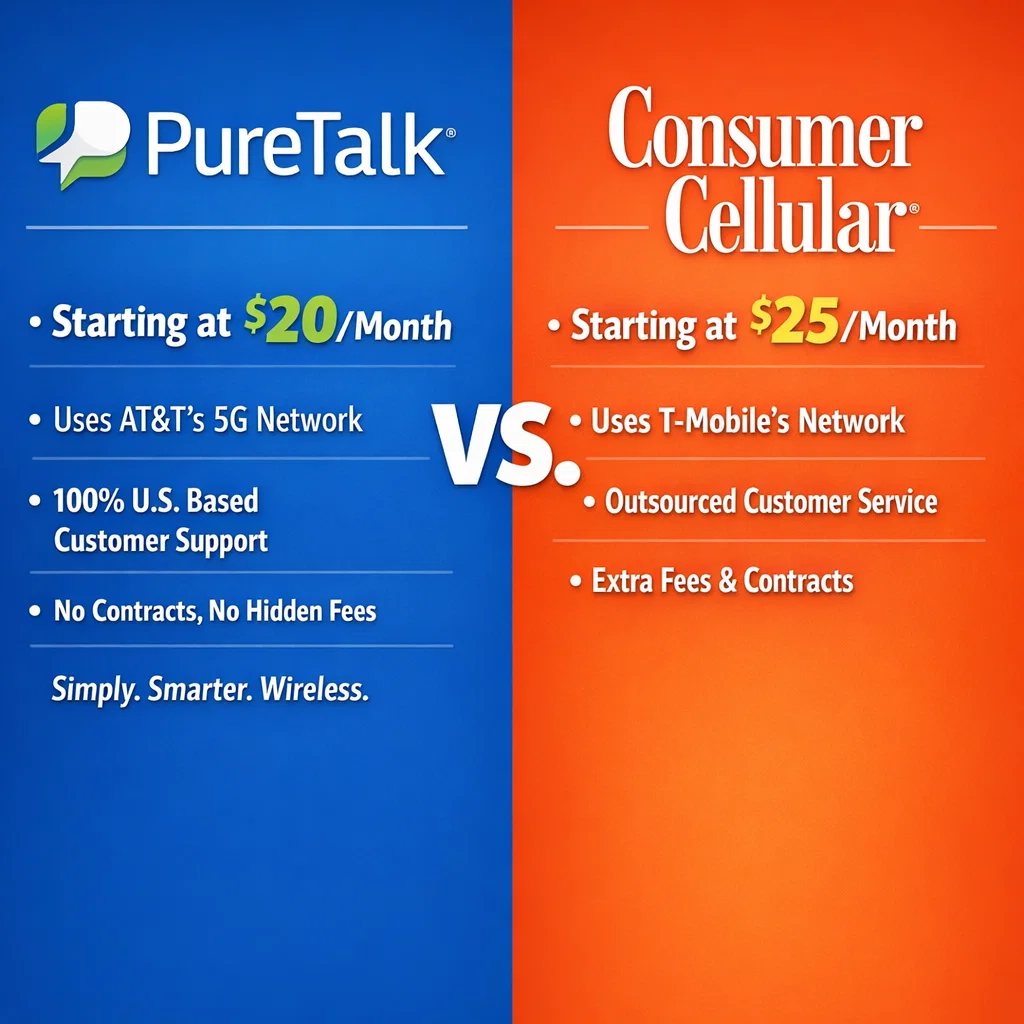
Choosing the right cell phone plan in 2026 can feel like navigating a maze. With major carriers pushing high prices and complex bundles, many users are looking toward MVNOs (Mobile Virtual Network Operators) like Pure Talk and Consumer Cellular.
Both of these companies use the same towers as the “big guys,” but they cater to different philosophies. One is a veteran-owned powerhouse focusing on military families and budget-conscious techies, while the other has built a legacy as the gold standard for seniors and AARP members.
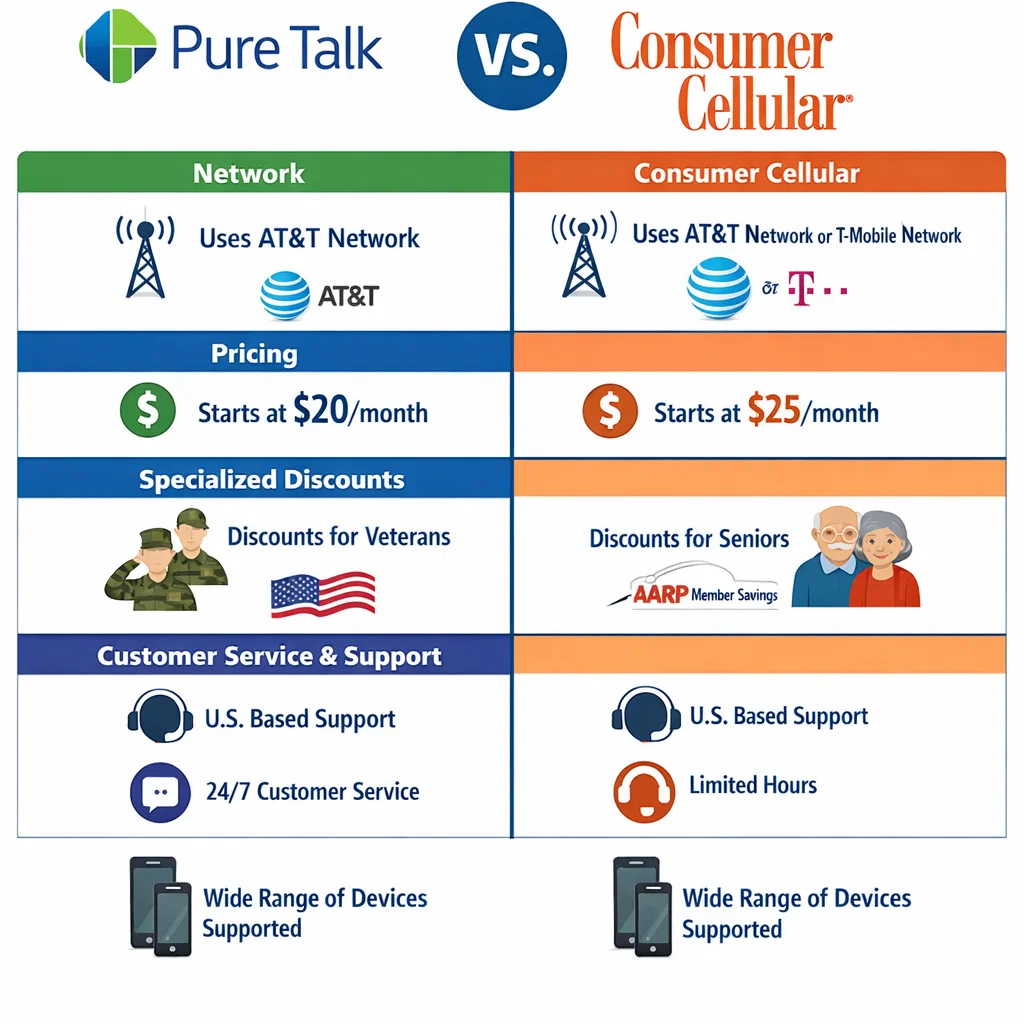
In this guide, we’re breaking down Pure Talk vs Consumer Cellular across every possible category: network strength, 2026 plan pricing, specialized discounts, and the “human factor” of customer service.
1. The Network Foundation: Who Powers Your Bars?
Before we look at the monthly bill, we have to look at the map. In 2026, the gap between “major carriers” and “budget carriers” has all but disappeared in terms of signal reach, but the technology behind them still matters.
The Pure Talk Network (AT&T)
Pure Talk runs exclusively on the AT&T network.
- Coverage: AT&T covers 99% of the American population. In 2026, Pure Talk users get full access to AT&T’s 5G and 5G+ (Mid-band) signals, which have expanded significantly to cover rural highways and small towns.
- Consistency: Because Pure Talk is a dedicated AT&T partner, you don’t have to worry about “switching” towers. If your current phone works on AT&T, it will work on Pure Talk.
The Consumer Cellular Network (AT&T & T-Mobile)
Consumer Cellular is unique because it uses a “multi-network” approach, though in 2026, the vast majority of their new activations are placed on the AT&T network.
- Flexibility: While they primary use AT&T towers, they still maintain agreements with T-Mobile in certain regions to fill in dead zones.
- The “Guest” Factor: Both carriers are “guests” on these networks. This means in a highly crowded area—like a sold-out 2026 Super Bowl or a massive downtown festival—the major network might “deprioritize” your data to keep their own $100-a-month customers fast.
2. 2026 Pricing: A Head-to-Head Comparison
Price is the number one reason people switch to these carriers. For 2026, both companies have updated their tiers to include more data for the same price.
Pure Talk 2026 Plans (Single Line)
Pure Talk is often slightly cheaper for users who need a specific amount of data.
- 3GB Plan: $20/month
- 10GB Plan: $30/month
- 25GB Plan: $45/month
- Unlimited Plan: $55/month (High-speed data up to 60GB, then slowed)
Consumer Cellular 2026 Plans (Single Line)
Consumer Cellular plans are designed for simplicity and often pair well with their multi-line discounts.
- 1GB Plan: $20/month
- 5GB Plan: $25/month
- 10GB Plan: $35/month
- Unlimited Plan: $50/month (High-speed data up to 35GB, then slowed)
The Price Verdict: If you are a single user who needs 10GB of data, Pure Talk is $5 cheaper. However, for “Unlimited” users, Consumer Cellular is $5 cheaper, though Pure Talk gives you a much higher “speed cap” (60GB vs 35GB).
3. Specialized Discounts: Seniors vs. Veterans
This is where the two companies truly diverge. They aren’t just competing on price; they are competing on values.
Consumer Cellular: The AARP King
Consumer Cellular is the only wireless provider that is an official partner of AARP.
- The 5% Discount: AARP members get 5% off their monthly service.
- The 2-Line Deal: In 2026, their most famous deal is two lines of unlimited data for $60. That is just $30 per line—one of the best deals in the country for couples.
Pure Talk: The Veteran-Owned Choice
Pure Talk is owned by a veteran and makes supporting the military a core part of its brand.
- The 20% Discount: Active military, veterans, and first responders get a permanent 20% discount off their monthly bill.
- Comparison: For a veteran, the Pure Talk “Unlimited” plan drops from $55 to $44, making it more affordable than Consumer Cellular’s standard unlimited plan.
4. The Human Factor: Customer Service & Support
In a world of AI chatbots, both of these companies have realized that their customers want to talk to a real person.
Consumer Cellular: The “Store” Experience
Consumer Cellular has a massive advantage for people who want in-person help.
- Target Partnership: You can walk into almost any Target store in the U.S. and find a Consumer Cellular display. A real person can help you swap a SIM card or pick out a new phone.
- Support: Their support is 100% U.S.-based and consistently wins J.D. Power awards for customer satisfaction.
Pure Talk: The “Fast & Direct” Experience
Pure Talk is also 100% U.S.-based.
- Location: Most of their support is based in the South (Georgia).
- Speed: Users in 2026 report that Pure Talk’s phone wait times are often shorter than Consumer Cellular’s during peak hours, though they lack the physical “store” locations that Consumer Cellular has at Target.
5. Device Compatibility: Bringing Your Own Phone
In 2026, you shouldn’t have to buy a new phone just to switch carriers.
- Bring Your Own Phone (BYOP): Both companies allow you to keep your current device as long as it is “unlocked.”
- eSIM Technology: Both carriers now fully support eSIM. This means you can switch from Verizon or T-Mobile to Pure Talk or Consumer Cellular in about 15 minutes right from your living room—no waiting for a SIM card in the mail.
- Selection: If you do want a new phone, Consumer Cellular offers a wider range of “senior-friendly” flip phones (like the IRIS Easy Flip), while Pure Talk focuses more on the latest iPhones and Samsung Galaxy devices.
Frequently Asked Questions
1. Does Pure Talk use Verizon towers?
No. Pure Talk is a dedicated AT&T partner. If you want a budget carrier that uses Verizon towers, you would look at Visible or Straight Talk.
2. Is Consumer Cellular better for seniors?
Generally, yes. Because of the AARP discount and the ability to get in-person help at Target, they are specifically designed for the needs of the 50+ community.
3. Which is better for military families?
Pure Talk wins here. Their 20% military discount applies to the entire bill, and they offer tiered discounts as you add more lines (up to 20% off for 4+ lines).
4. What happens if I use all my data?
On both carriers, you will never get an “overage charge.”
- On Pure Talk, your speed slows down to 256kbps once you hit your cap.
- On Consumer Cellular, they will often automatically “upgrade” you to the next plan tier for that month to keep your speeds fast, which is a feature people either love or hate.
5. Do they offer 5G in 2026?
Yes. Both carriers include full 5G and 5G+ access for no extra charge. You just need a 5G-capable phone (like an iPhone 13 or newer).
6. Can I keep my number?
Absolutely. Both carriers allow you to “port” your current number. You just need your account number and “transfer PIN” from your current provider.
Final Verdict: Which One Wins in 2026?
The “winner” of Pure Talk vs Consumer Cellular depends on which group you belong to.
- Choose Consumer Cellular if: You are an AARP member, you want the best “2-line” deal for couples ($60 total), or you want the peace of mind of being able to walk into a Target store for help.
- Choose Pure Talk if: You are a veteran or first responder (20% off), you want higher high-speed data caps (60GB on unlimited), or you want a simple, veteran-owned company that gives you more data for your dollar on mid-tier plans.
In 2026, the real victory is simply leaving the high-priced major carriers. Both Pure Talk and Consumer Cellular offer the same nationwide coverage you are used to for half the price.