
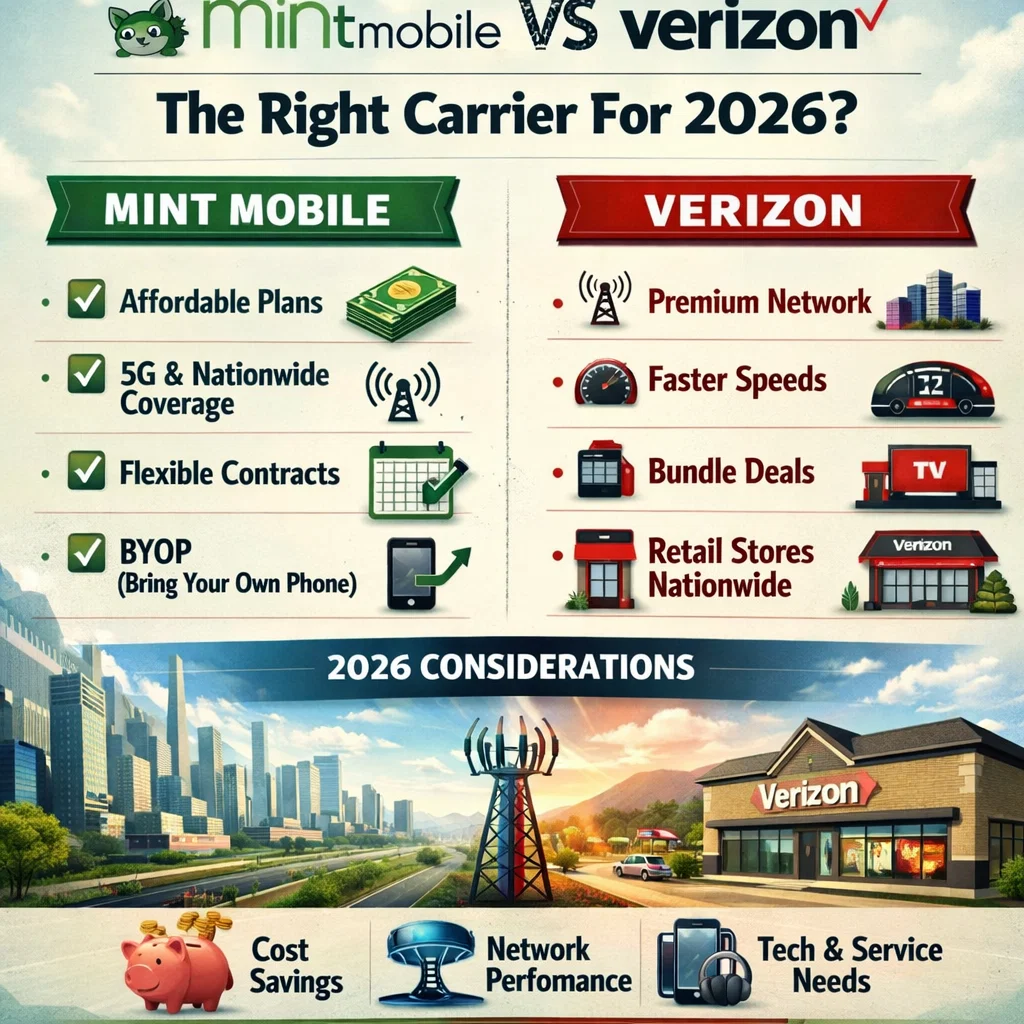
Deciding on a cellular provider remains one of the most tedious modern chores. Our lives revolve around these devices. I use mine for professional calls, keeping in touch with my family, and the occasional mindless scrolling while commuting. Naturally, I want a plan that is cost-effective. However, I also require a service that actually functions when I need it most.
In the past, our options were limited to a few massive corporations and even larger monthly bills. As we enter 2026, the landscape has shifted significantly. Smaller carriers have matured, while the giants have introduced new technologies to stay relevant. I have personally tested both services to help you solve this puzzle. In this analysis of Mint Mobile vs Verizon, I will share what I’ve learned from the front lines.
I have scrutinized the fine print and analyzed coverage maps until my eyes ached. Most reviews simply recite a list of prices. I won’t do that. I intend to provide a transparent look at the reality of using these carriers in 2026. By the time you finish reading, you will know exactly which direction to take.
Mint Mobile vs Verizon: Let’s Start Comparing
1. Infrastructure: Who Truly Owns the Network?
Before you decide between Verizon vs Mint Mobile, you must understand the underlying infrastructure. The industry is divided into two distinct categories.
First, we have the “Big Three”—Verizon, AT&T, and T-Mobile. These giants own the physical towers and spend billions on maintenance. Verizon is a primary owner. They build their own network and control every piece of equipment on those towers.
Then there are MVNOs, or Mobile Virtual Network Operators. Historically, these companies rented space on the big towers. However, the situation changed in 2026. T-Mobile now fully owns Mint Mobile. This shift is vital. Mint is no longer a mere “guest” on the network; it is a permanent part of the T-Mobile ecosystem.
When I use Mint, I am tapping into T-Mobile’s expansive 5G network. I appreciate the stability this ownership provides. However, I’ve noticed that even though they are family now, Mint users are still treated differently during peak hours.
2. Coverage: Marketing vs. My Reality
Marketing maps always look perfect. Both companies claim to cover nearly the entire population. But I’ve learned that covering “people” is not the same as covering “places.”
Verizon’s Rural Dominance
Verizon remains the leader in rural connectivity. If I find myself in a remote town or a national park, Verizon usually provides the only reliable signal. In 2026, they introduced satellite-to-phone technology through AST SpaceMobile. This is a game-changer for safety. If I’m hiking in a “dead zone,” my phone can now connect to a satellite for emergency texts and calls.
Mint Mobile’s Urban Edge
Mint utilizes T-Mobile’s towers, which currently boast the most 5G sites in the country. In major metropolitan areas, my speeds on Mint are often superior to Verizon. However, the signal fades quickly once I leave the city limits. I tested this on a recent road trip. While my phone was a “paperweight” in the mountains, my companion on Verizon was still streaming high-definition video.
3. Performance: The Speed and Latency Factor
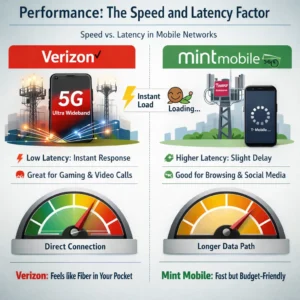
When comparing Verizon or Mint Mobile, most people focus on download speeds. However, I pay closer attention to “latency”—the time it takes for a data request to actually start.
Verizon owns its towers, so their latency is incredibly low. When I click a link, the page begins to load almost instantly. For mobile gaming or professional video calls, this responsiveness is essential. Their 5G Ultra Wideband feels like having a dedicated fiber line in my pocket.
Mint is also remarkably fast. In many cities, T-Mobile’s 5G raw speed actually beats Verizon. However, because Mint is a budget-tier brand, the data often takes a slightly longer path to reach you. I notice a split-second delay when starting a video. For most people, this is negligible. If you are just checking emails or social media, you won’t feel the difference.
4. The “VIP Room” Problem (Deprioritization)
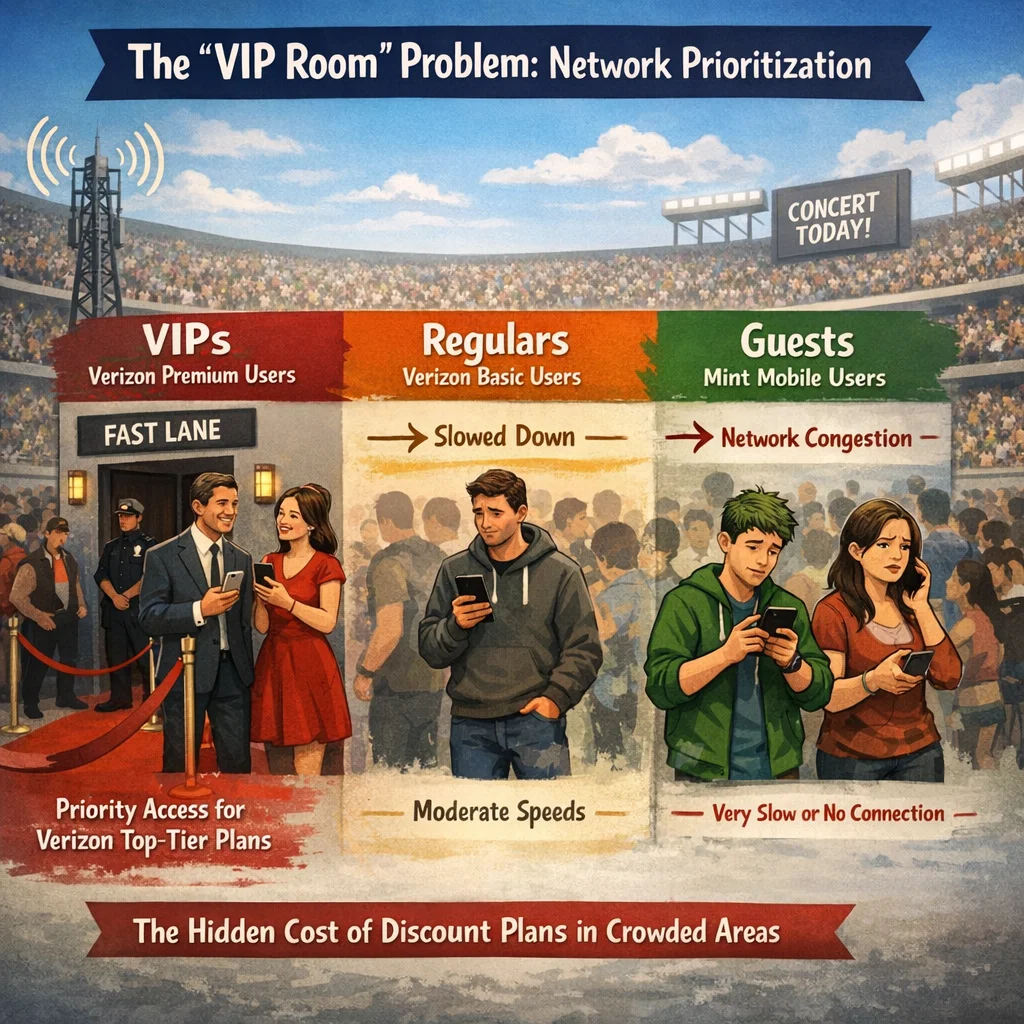
This is the most critical element of the Mint Mobile or Verizon debate. Imagine standing in a crowded stadium with 70,000 other fans. Everyone is trying to upload a video simultaneously. The cell tower must prioritize traffic.
- The VIPs: Users on Verizon’s top-tier unlimited plans. They get the fastest lane, regardless of the crowd.
- The Regulars: Users on Verizon’s basic plans. They might see a slight slowdown.
- The Guests: Mint Mobile users. Even under T-Mobile ownership, Mint is considered “prepaid.”
I have experienced moments in crowded areas where my Mint phone simply stopped working. I couldn’t even load a basic map. Meanwhile, those on premium Verizon plans were browsing without issue. This is the “hidden cost” of the discount. It doesn’t happen daily, but it is incredibly frustrating when it does.
5. Pricing Strategy for 2026
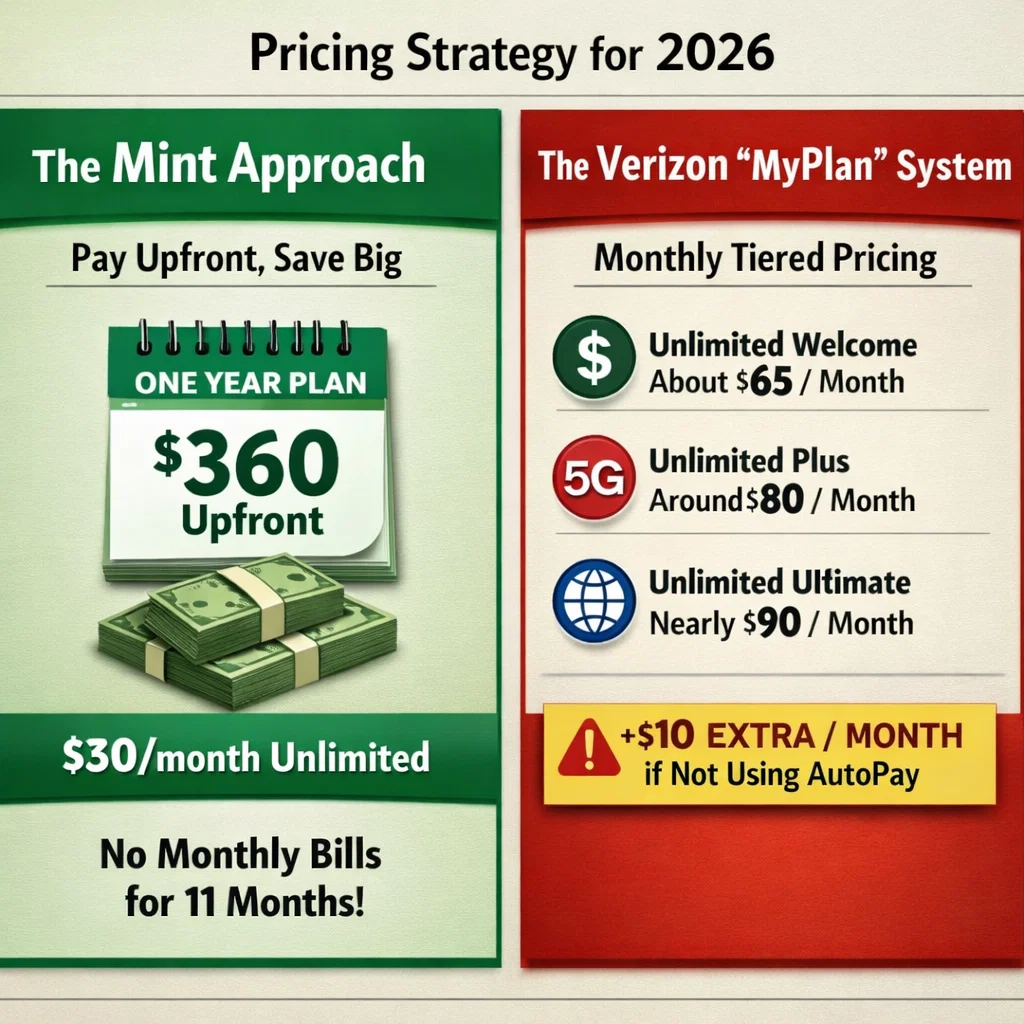
This is where Mint usually wins the argument, but the billing philosophies are worlds apart.
The Mint Approach
Mint doesn’t believe in monthly bills. They sell data in bundles. To get the best price—like their $30/month Unlimited plan—I have to pay for the entire year upfront. Writing a check for $360 at once can be a hurdle. However, I love the feeling of not having a phone bill for the next eleven months. It simplifies my budget immensely.
The Verizon “MyPlan” System
Verizon bills monthly, and in 2026, they use a tiered “MyPlan” system.
- Unlimited Welcome: Roughly $65 for a single line.
- Unlimited Plus: About $80, including the fastest 5G speeds.
- Unlimited Ultimate: Nearly $90, geared toward international travelers.
I should note that these prices require “AutoPay.” If I were to pay by check, Verizon would tack on an extra $10 every month.
6. The Perks vs. Simplicity
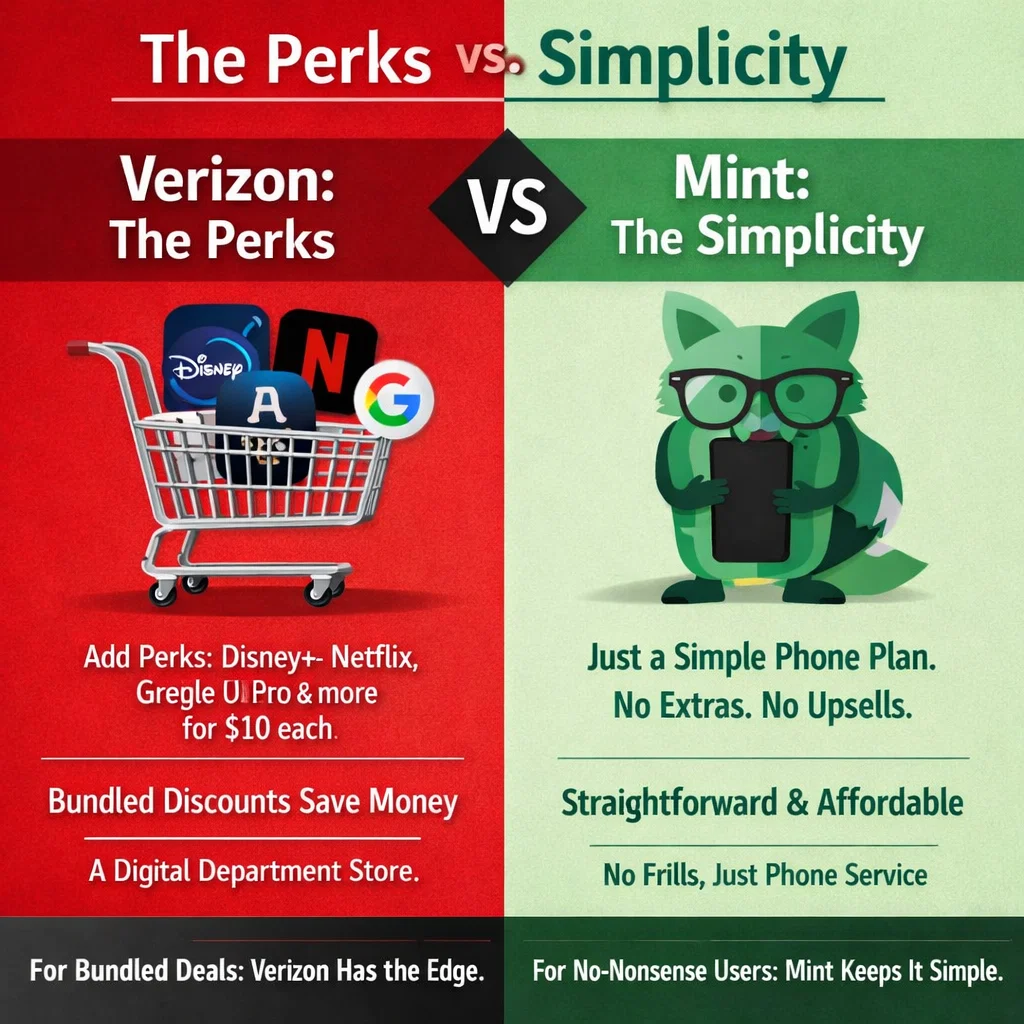
Verizon operates like a digital department store. They allow me to add “Perks” like Disney+, Netflix, or the Google AI Pro bundle for $10 each. If I am already paying for these services, getting them through Verizon saves me money. It’s an ecosystem play.
Mint offers zero perks. They provide a phone plan and nothing else. I personally prefer this simplicity. I don’t want my phone carrier to also be my streaming provider. However, if you enjoy bundled discounts, Verizon has the clear advantage.
7. The Family Plan Flip
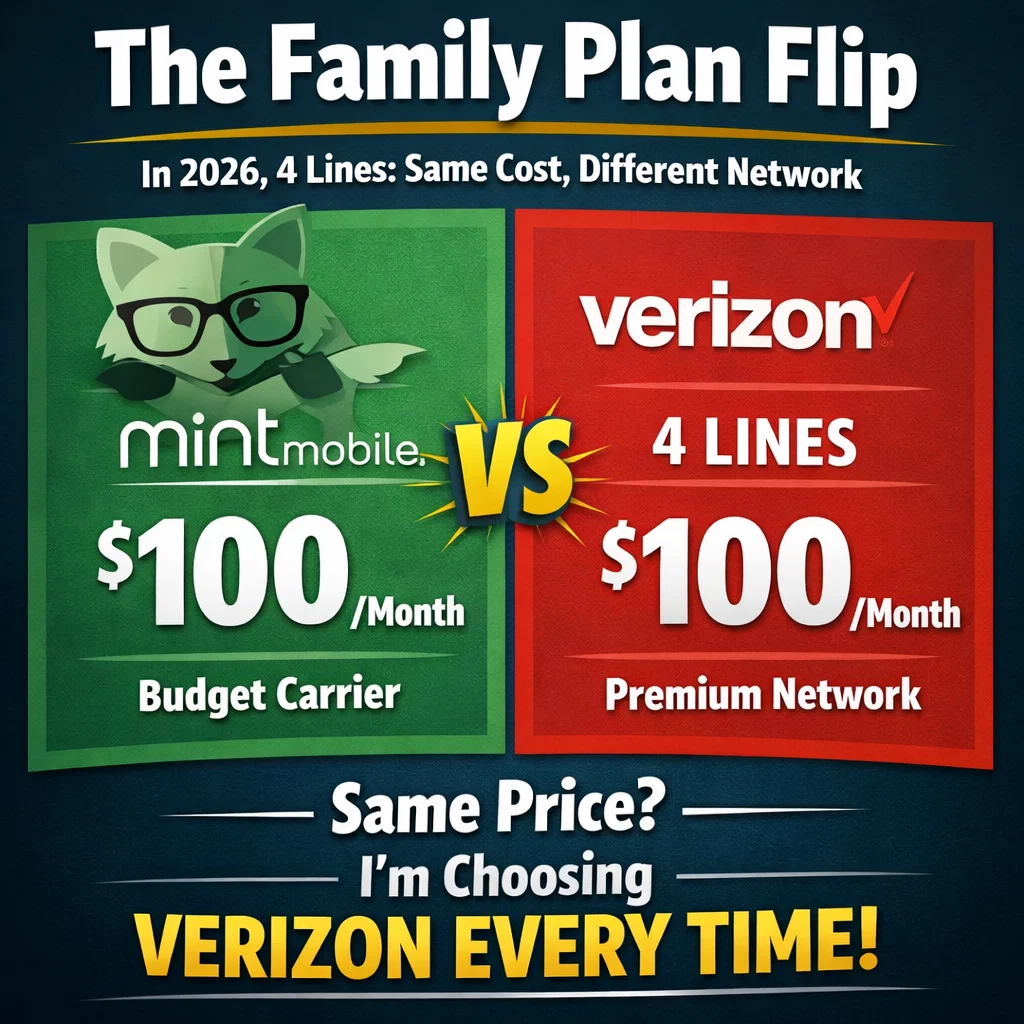
If you are a single user, the choice between Mint Mobile vs Verizon is easy: Mint is cheaper. But for families, the math changes. Verizon offers massive discounts as you add more lines. In 2026, four lines on Verizon can cost nearly the same as four lines on Mint. If I can get the premium “Big Three” network for the same price as a budget carrier, I’m choosing Verizon every time.
Common Questions
Does Mint Mobile use the same towers as Verizon?
No, they operate on completely different networks. In my experience, this is the most common misconception. Mint Mobile and Verizon use different “engines”—Mint runs on T-Mobile’s infrastructure, while Verizon uses its own proprietary towers. If you switch from Verizon to Mint Mobile, you are moving from one network ecosystem to another entirely.
Why are so many customers leaving Verizon?
From what I’ve seen, it usually comes down to the “wallet factor.” Verizon’s monthly bills are significantly higher, and their 36-month phone contracts can feel restrictive. Many people are realizing they can get similar urban 5G speeds for a fraction of the price when comparing Verizon vs Mint Mobile. The lack of transparency in monthly fees is a major deterrent.
Why is my phone so slow with Mint Mobile?
It’s likely due to “deprioritization”—what I call the VIP problem. Because Mint is a budget brand, T-Mobile sometimes slows down Mint data during heavy traffic to keep its own direct customers fast. Additionally, if you leave a major city, you might notice a dip in performance because T-Mobile’s rural reach isn’t always as robust as Verizon or Mint Mobile’s urban coverage.
Who is the actual carrier for Mint Mobile?
The actual carrier is T-Mobile. As of 2026, T-Mobile is no longer just a partner; they are the parent company that fully owns Mint Mobile. When you use Mint, you are essentially using T-Mobile’s infrastructure, which is why the 5G speeds are often so impressive in metropolitan areas.
Final Verdict: Which Should You Choose?
Choose Mint Mobile if:
- You are an individual user looking to save over $500 annually.
- You live and work primarily in a major city.
- You prefer a simple, “pay once and forget it” yearly model.
- You already own your phone and want to avoid contracts.
Choose Verizon if:
- You live in a rural area or frequent “dead zones.”
- You have a family of three or more.
- You want the latest “free” iPhone or Galaxy (and don’t mind a 36-month commitment).
- You value having a physical store to visit when things go wrong.
I personally made the switch to Mint because I live in an urban environment and hate monthly bills. The savings allowed me to upgrade my laptop sooner than expected. However, my brother, who lives in the mountains, found Mint unusable. He pays the Verizon premium because he needs his phone to work in the woods.
Check your local coverage, review your bank statement, and choose the tool that fits your life.
Would you like me to analyze the specific coverage maps for your zip code to see which carrier has more 5G towers in your neighborhood?