
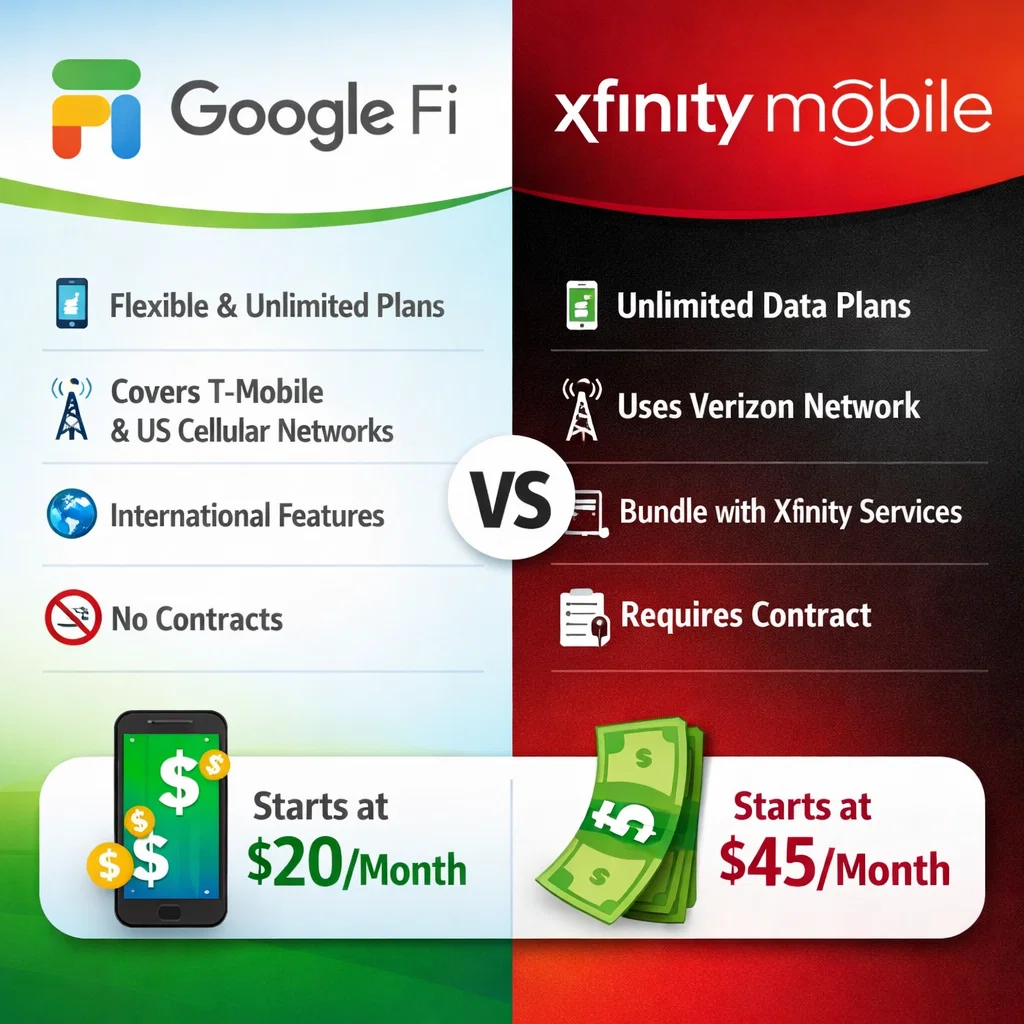
You are probably here because you’re tired of paying $90 a month to Verizon or AT&T. You want the same coverage for half the price.
Both Google Fi vs Xfinity Mobile promise exactly that. They both piggyback on major networks to give you 5G coverage without the premium price tag. But here is the problem most reviews won’t tell you: One of these carriers is a dream for travelers, and the other is a trap if you don’t read the fine print.
I’m going to break down the Google Fi vs Xfinity Mobile battle without the marketing fluff. We will look at speed, coverage, hidden fees, and the one “dealbreaker” rule that might disqualify you from Xfinity immediately.
Let’s figure out which one actually belongs in your pocket.
Google Fi vs Xfinity Mobile: Who is Better?
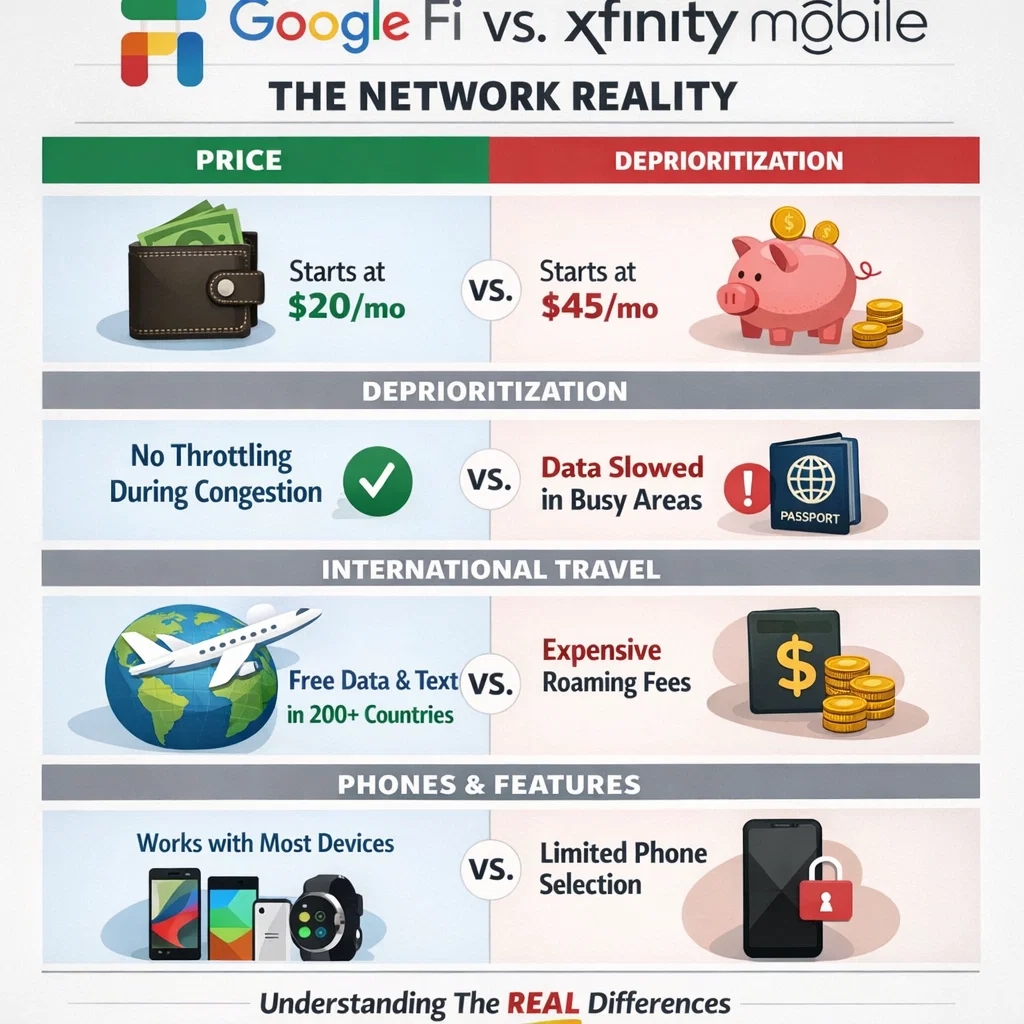
If you don’t want to read, here is the cheat sheet.
- Pick Google Fi IF: You travel internationally, you own a Google Pixel phone, or you live in a major city with strong T-Mobile 5G coverage.
- Pick Xfinity Mobile IF: You already have Xfinity Home Internet (Comcast), you want the best coverage in rural areas (Verizon towers), or you need a cheap family plan for 3+ lines.
The Golden Rule: Do not switch to Xfinity Mobile if you plan to cancel your Xfinity home internet soon. If you cancel your home internet, Xfinity adds a $25/month fee per line to your mobile bill. Suddenly, that “cheap” plan becomes very expensive.
1. The Network Reality: Whose Towers Are Better?
When you choose an MVNO (Mobile Virtual Network Operator) like these two, you aren’t buying their network. You are buying access to a big carrier’s towers.
Google Fi = T-Mobile (Plus Some Magic)
Which carrier is Google Fi using? Google Fi runs primarily on the T-Mobile 5G network.
- The Pro: T-Mobile currently has the fastest and widest 5G coverage in the United States. If you live in a metro area, your speeds on Fi will often blaze past 300 Mbps.
- The “Magic”: If you use a “Designed for Fi” phone (like a Pixel or Samsung Galaxy), Google Fi can also automatically connect you to millions of secure open Wi-Fi hotspots to save your data.
Xfinity Mobile = Verizon (The King of Coverage)
Whose towers does Xfinity Mobile use? Xfinity Mobile uses Verizon’s network.
- The Pro: Verizon is still the king of highway and rural coverage. If you drive cross-country or live in the suburbs, you will likely have a signal with Xfinity in places where Google Fi (T-Mobile) drops to zero.
- The “Magic”: Xfinity has millions of Wi-Fi hotspots in people’s homes and businesses. Your phone will auto-connect to these “Xfinity WiFi” zones to save data.
Winner:
- Speed: Google Fi (T-Mobile 5G is faster).
- Reliability: Xfinity Mobile (Verizon covers more rural dead zones).
2. Google Fi vs Xfinity Mobile Price: The Monthly Math
This is where the battle gets messy. The Google Fi vs Xfinity Mobile cost comparison depends entirely on how many people are in your family.
Single Line Users (The Loner Tax)
If you are just paying for yourself, Xfinity Mobile is cheaper.
- Xfinity Mobile: You can get their “Unlimited Intro” plan for roughly $40/month. Or, if you barely use data, you can pay “By the Gig” for as low as $20.
- Google Fi: Their comparable “Unlimited Standard” plan is $50/month. They do have a “Flexible” plan for $20, but data is $10/GB. If you use more than 3GB, you are already paying more than Xfinity.
Family Plans (The Bundle War)
If you have a family of 4, the Google Fi vs Xfinity Mobile price gap closes.
| Feature | Google Fi (Unlimited Simply) | Xfinity Mobile (Unlimited Intro) |
| Price for 4 Lines | $100 total ($25/line) | ~$120 total ($30/line avg) |
| Data Limit | 35GB per person | 30GB per person |
| Throttling Speed | 256 kbps (Unusable) | 1.5 Mbps (Usable) |
| Hotspot | 5GB Included | Unlimited (at 3G speed) |
| Taxes & Fees | Extra (~10-15%) | Extra (~10-15%) |
Wait, what about throttling?
This is crucial. Both carriers slow you down if you use too much data.
- Google Fi: Hard throttle. Once you hit your limit (35GB on Standard), you are slowed to 256 kbps. You can barely load an email.
- Xfinity Mobile: Soft throttle. Once you hit 30GB, you are slowed to 1.5 Mbps. This is slow, but you can still browse the web and stream low-quality music.
Winner:
- Single Users: Xfinity Mobile.
- Families (4+ lines): Google Fi is cheaper per line ($25 vs $30+).
3. The “Hidden” Gotchas: Deprioritization & Eligibility
We need to talk about “Deprioritization.” This is a fancy word for “traffic jam.”
Why is my Xfinity 5G so slow?
Because you are second in line. Since Xfinity uses Verizon’s towers, Verizon prioritizes its own direct customers first. If you are at a crowded concert or a busy stadium, your Xfinity data might stop working while your friend with real Verizon is fine.
- The Fix: You can pay extra for Xfinity’s “Unlimited Premium” plan to get “priority data” that doesn’t slow down in crowds.
Google Fi’s Secret Weapon:
Google Fi’s “Unlimited Plus” plans have the same priority as T-Mobile Direct customers. You generally won’t get slowed down in crowds just because the network is busy.
The Xfinity Eligibility Trap:
I mentioned this earlier, but I need to repeat it. You CANNOT sign up for Xfinity Mobile without Xfinity Internet.
- If you move to a house that doesn’t have Comcast/Xfinity, you have to cancel your phone plan or pay a penalty fee.
- Google Fi works for anyone, anywhere in the US. No cable subscription required.
4. International Travel: The Knockout Punch
If you have a passport, stop reading and buy Google Fi. This isn’t even a fair fight.
Google Fi (Unlimited Plus Plan):
- Cost: $0 extra.
- Coverage: Free high-speed data in 200+ countries.
- Experience: You land in London, turn off airplane mode, and your phone just works. No buying SIM cards at the airport. No daily fees. It uses your normal data allowance.
Xfinity Mobile:
- Cost: Expensive.
- Coverage: They offer a “Global Travel Pass.”
- The Price: $10 per day per line.
- The Math: If you go on a 10-day trip to Europe, Xfinity will charge you an extra $100. Google Fi charges you $0.
Winner: Google Fi. It is the best travel carrier in the world, period.
5. Phones & Features: iPhone vs. Pixel
The iPhone Situation
For a long time, Google Fi was terrible on iPhones. You had to manually change settings to get texts to work.
- In 2025: Google Fi works well on iPhone (5G and Hotspot are supported), but you still don’t get the “Network Switching” feature. You are stuck on T-Mobile only.
- Xfinity: Works natively with iPhone. Visual voicemail, Wi-Fi calling, and setup are seamless, just like Verizon.
The Smartwatch Deal
- Google Fi: Offers full connectivity for Pixel Watches and Samsung Galaxy Watches at no extra cost on the Simply Unlimited plan.
- Xfinity: Charges $10/month to add a smartwatch line.
6. Frequently Asked Questions
Which carrier is Google Fi using?
Google Fi uses the T-Mobile 5G network. They used to use US Cellular and Sprint as well, but now they are exclusively T-Mobile for the main signal, supplemented by a massive network of Wi-Fi hotspots.
Who is Xfinity’s biggest competitor?
Technically, it is Spectrum Mobile. Both are cable companies that force you to bundle internet. However, regarding value for money, their biggest competitor is Mint Mobile (which also runs on T-Mobile and is cheaper) and Visible (which runs on Verizon and is cheaper).
Whose towers does Xfinity Mobile use?
Xfinity Mobile uses Verizon’s towers. This gives them excellent nationwide coverage, especially in rural areas where T-Mobile (Google Fi) might struggle.
Why is my Xfinity 5G so slow?
There are two likely reasons.
- Congestion: You are in a crowded area, and Verizon is “deprioritizing” your data to speed up their own direct customers.
- The Cap: You exceeded your 30GB data limit for the month. Once you pass this, Xfinity slows you down to 1.5 Mbps until the next billing cycle.
Final Verdict: Making the Choice
We have analyzed the Google Fi vs Xfinity Mobile rivalry from every angle. Here is your final checklist.
Choose Google Fi if:
- You travel abroad: Even once a year, the savings are massive.
- You love Android: The integration with Pixel and Samsung is flawless.
- You hate contracts: You want the freedom to switch home internet providers without breaking your phone bill.
- You want fast 5G: You live in a city and want the fastest possible download speeds.
Choose Xfinity Mobile if:
- You are a Comcast lifer: You have Xfinity Internet and don’t plan on moving or switching soon.
- You are a solo user: The single-line pricing is better than Fi’s.
- You live in the country: You need Verizon’s rural tower reach.
- You are an iPhone family: The setup is slightly smoother and feels more “native” than Fi on iOS.
My Personal Recommendation:
If I lived in the suburbs with Xfinity Internet, I would grab Xfinity Mobile for the bundle savings. But as someone who travels and works from coffee shops? I’d pay the extra few dollars for Google Fi just to avoid the headache of international roaming fees.
Which one fits your life? The traveler’s freedom of Fi, or the bundled savings of Xfinity? The choice is yours.