
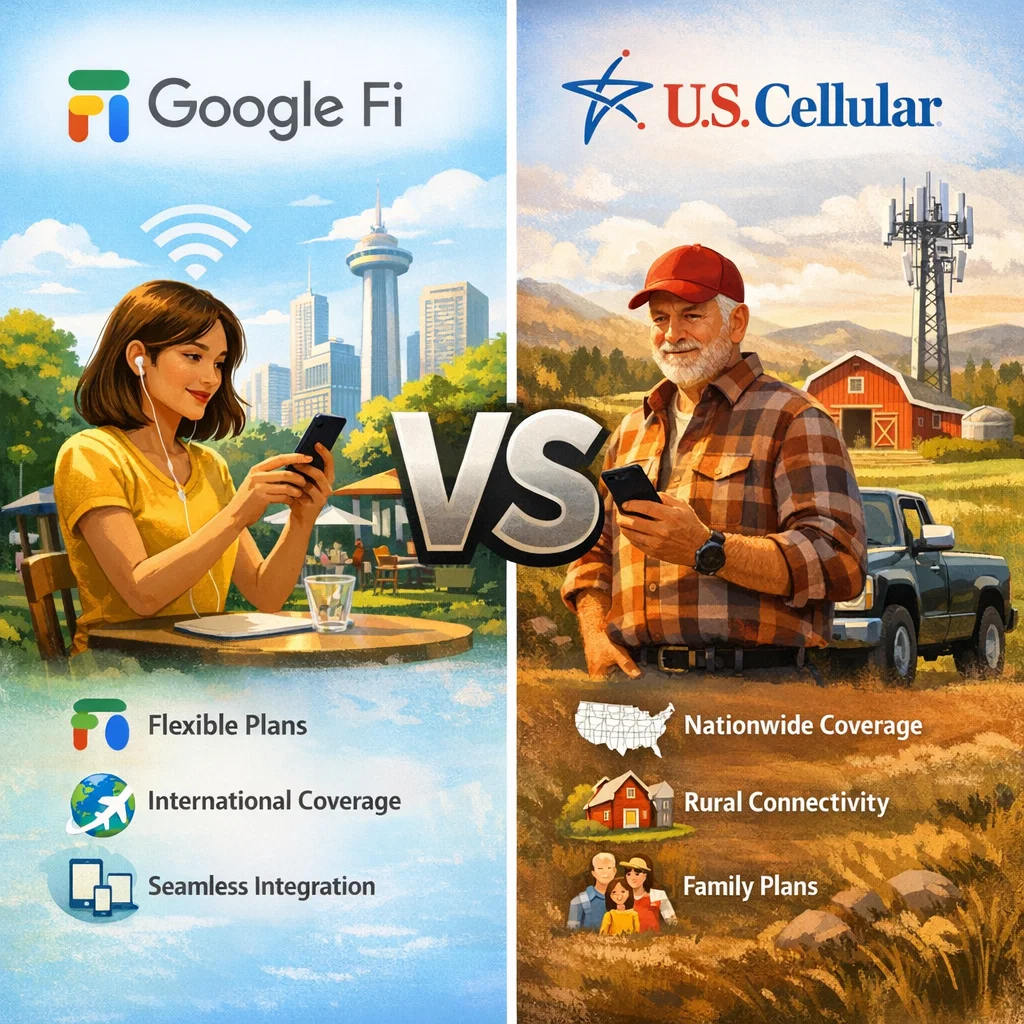
Choosing a phone plan used to be simple. You just picked the one with the best bars in your house. But today, it is a lot more complicated. If you are stuck deciding between Google Fi vs US Cellular, you are not alone. These are two very different carriers that often get compared for the wrong reasons.
For a long time, these two were actually partners. Google Fi phones used to jump onto US Cellular towers to get better signal in rural areas. But that has changed. The partnership is different now, and T-Mobile is getting involved in a big way.
In this guide, we are going to break down the difference between Google Fi and US Cellular. We will look at price, coverage, data speeds, and perks. By the end, you will know exactly which SIM card belongs in your phone.
Google Fi vs UScellular The Big “Network” Update
Before we talk about money, we have to talk about towers. This is the most important part of the Google Fi vs US Cellular debate.
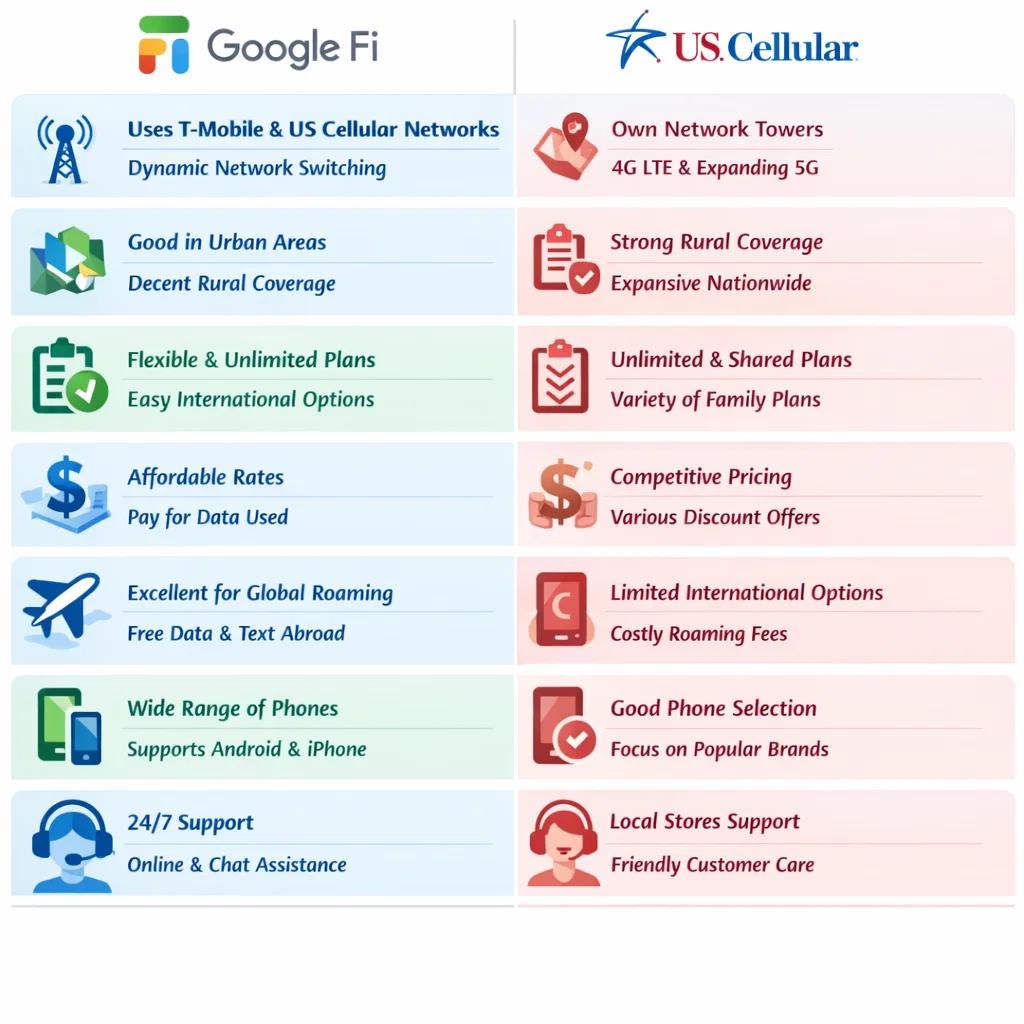
Google Fi is what is called an MVNO (Mobile Virtual Network Operator). That is a fancy way of saying they don’t own their own towers. Instead, they rent them. For years, Google Fi used a mix of T-Mobile, Sprint, and US Cellular towers. Your phone would smartly switch to whichever signal was strongest.
However, that has changed.
Google Fi now primarily relies on the T-Mobile network. The “network switching” feature that made Google Fi famous is largely gone for new devices.
US Cellular, on the other hand, owns their own towers. They are a regional powerhouse. They are incredibly strong in the Midwest, parts of the Northwest, and rural areas where the big giants (like Verizon or AT&T) struggle.
The takeaway:
- If you live in a big city or the suburbs, Google Fi (via T-Mobile) will likely be faster.
- If you live in rural Wisconsin, Iowa, or Oregon, US Cellular might be the only one that works.
Google Fi vs US Cellular Coverage and Reception: City vs. Country
When comparing US Cellular vs Google Fi, location is everything.
Google Fi Coverage
Since Google Fi rides on T-Mobile’s 5G network, it has massive coverage across the United States. T-Mobile has the largest 5G network in the country. This means if you are in a metro area, you are going to get blazing fast speeds.
I have tested Google Fi in airports and coffee shops, and it flies. But, because it is an MVNO, there is a catch. In times of heavy traffic—like at a concert or a football game—your data might get slowed down before a direct T-Mobile customer.
US Cellular Coverage
US Cellular is different. They are famous for covering the “middle of nowhere.” They have towers in valleys and farm towns where other carriers have “No Service.”
However, they are regional. That means they don’t have native towers in every single state. When you leave their home area, you are “roaming.” They have agreements so your phone still works, but it isn’t their native network.
Winner:
- Google Fi wins for nationwide city and travel coverage.
- US Cellular wins for rural reliability in their specific home states.
Google Fi vs US Cellular Plans and Pricing: Who Has the Better Deal?
Let’s talk about your wallet. This is usually the tie-breaker when choosing Google Fi or US Cellular.
Google Fi Plans
Google Fi likes to keep it simple. They really only have three main options:
- Flexible Plan: This is great for people who use Wi-Fi all the time. You pay a low base fee (around $20 for talk and text) and then pay $10 for every gigabyte of data you use. If you use zero data, your bill is tiny.
- Simply Unlimited: This is their standard unlimited plan. It is affordable, especially if you have a family line. It includes data in the US, Canada, and Mexico.
- Unlimited Plus: This is the “power user” plan. It includes unlimited data, a hotspot for your laptop, and their famous international travel features (more on that later).
Pro Tip: Google Fi prices get much cheaper if you add more people to your “group.” A single line is pricey, but a line of 4 people is a steal.
US Cellular Plans
US Cellular operates more like the big traditional carriers. They have:
- Basic Unlimited: Good for talk and text, but they might slow your data down if the network is busy.
- Everyday Unlimited: Adds some perks and better priority data.
- Even Better Unlimited: This is the top tier. It includes HD video streaming and movie rental perks (sometimes they offer Redbox deals or similar).
The confusing part about Google Fi vs UScellular pricing is the hidden fees. US Cellular often advertises a low price, but you have to watch out for taxes and fees. Google Fi usually includes taxes in their visible pricing on the Unlimited plans, which is a nice touch.
Winner:
- Google Fi wins for low-data users and families of 3+.
- US Cellular wins if you can grab a local promotion or “new line” deal.
The Traveler’s Choice: Google Fi Dominates
If you have a passport, stop reading and just get Google Fi. This is not even a fair fight.
When you land in a new country with Google Fi (on the Unlimited Plus or Flexible plan), your phone just works. You get off the plane, turn off Airplane Mode, and boom—you have data. You don’t have to pay extra daily fees. You don’t have to hunt for a local SIM card. It works in over 200 destinations.
With US Cellular, international travel is harder. You usually have to pay for a “Travel Pass” or pay expensive Pay-As-You-Go rates. It adds up very fast.
For example, if you go to Europe for 10 days:
- Google Fi: $0 extra (it uses your normal plan data).
- US Cellular: Could cost you $100+ in daily passes.
The difference between Google Fi and US Cellular here is massive. Google Fi was literally built for travelers.
Phone Selection and Compatibility
“Designed for Fi”
Google Fi works best with “Designed for Fi” phones. These are usually Google Pixel phones (like the Pixel 9 or 9 Pro) and some Samsung Galaxy phones. These phones have special software to handle the network smartly.
You can bring an iPhone to Google Fi. It works fine now! A few years ago, it was a headache. You had to change settings manually to get text messages to work. Today, it is much smoother, though you still miss a few tiny features like automatic network switching (which matters less now anyway).
US Cellular Phones
US Cellular sells all the major flagships. You can walk into a store and buy the latest iPhone or Samsung Galaxy on a payment plan. This is a big advantage for some people. If your phone breaks, you can walk into a US Cellular store in your town and get help.
With Google Fi, there are no stores. If your phone breaks, you are dealing with online chat support and mailing boxes back and forth.
Winner:
- US Cellular wins if you like physical stores and easy iPhone upgrades.
- Google Fi wins if you love Android/Pixel phones.
Google Fi vs US Cellular Customer Service: App vs. Store
Do you hate talking to people? Or do you like shaking hands?
Google Fi is 100% digital. The Google Fi app is actually amazing. You can pause your service, check your data usage, and chat with support right in the app. It is clean, modern, and fast. But if things go really wrong, it can be frustrating not having a human face to yell at.
US Cellular has brick-and-mortar stores. For many people, especially older users or those who aren’t tech-savvy, this is a dealbreaker. Being able to drive to the strip mall and have “Dave” fix your SIM card is a valuable service.
The “T-Mobile” Acquisition Elephant
We can’t write a blog about US Cellular vs Google Fi without mentioning the news. T-Mobile is in the process of buying a huge chunk of US Cellular.
What does this mean for you? It means these two competitors might soon be on the same team. If you sign up for US Cellular today, there is a good chance you will eventually be migrated to the T-Mobile network anyway.
Since Google Fi already runs on T-Mobile, the gap between these two services is shrinking. In a few years, the coverage might be exactly the same. But for right now, the distinction still matters for rural access.
Verdict: Google Fi or US Cellular?
So, who wins the battle of Google Fi vs UScellular? Here is the final breakdown based on your lifestyle.
Choose Google Fi if:
- You travel internationally. This is the number one reason to buy Fi.
- You use very little data. The Flexible plan can save you a fortune.
- You are a techie. You prefer managing things via an app and don’t need a physical store.
- You have a Google Pixel phone. The integration is seamless.
- You live in a city. You will enjoy fast 5G speeds.
Choose US Cellular if:
- You live in a rural area. Specifically in the Midwest or Pacific Northwest where T-Mobile has dead zones.
- You want a physical store. You want to talk to a human when you buy a phone or pay a bill.
- You want a bundled phone deal. They often offer “Free iPhone” deals if you switch and sign a contract.
- You have a large family. Their multi-line discounts can sometimes beat Fi depending on current promotions.
Frequently Asked Questions
1. Does Google Fi still use US Cellular towers?
No, not in the way they used to. Google Fi has ended its official “network switching” partnership with US Cellular. Google Fi now primarily uses T-Mobile’s network. However, you might still roam on US Cellular towers in certain areas, but it is not a core feature anymore.
2. Is Google Fi cheaper than US Cellular?
It depends on how you use it. If you are a single person who uses less than 2GB of data a month, Google Fi is much cheaper. If you need unlimited data for a family of four, the prices are very similar, but US Cellular might offer better phone financing deals.
3. Can I keep my number if I switch between them?
Yes! Both carriers allow you to “port” (transfer) your phone number. You just need your account number and a PIN from your current carrier to make the switch.
4. Which carrier has better 5G?
Generally, Google Fi (via T-Mobile) has faster and more widespread 5G speeds nationwide. US Cellular has decent 5G, but it is limited to their specific regions.
5. What is the main difference between Google Fi and US Cellular?
The main difference is infrastructure. US Cellular owns their own towers and focuses on rural, regional coverage. Google Fi rents T-Mobile’s towers and focuses on flexibility, app-based management, and international travel.
Choosing between Google Fi vs US Cellular comes down to where you live and where you go. Check the coverage maps for your specific zip code before signing up!