
Is the “Contract” still worth it now that T-Mobile owns the network?
You are reading this as T-Mobile now owns the network. I believe you are probably confused between US Cellular prepaid vs contract plans. So, let’s clear this confusion!
You know US Cellular was bought by T-Mobile last year (August 2025). You see the “Now Part of T-Mobile” signs in the store windows. But you still see “US Cellular” plans on the website.
So, the big question is: Do you stick with a flexible Prepaid plan, or do you lock yourself into a 36-month Contract?
Most older articles will tell you that Prepaid has bad coverage. That information is outdated. The merger changed everything.
I have analyzed the new 2026 network maps, the T-Mobile integration policies, and the fine print to give you the only guide you need.
The 2026 Reality: The “Merger” Factor
Before we talk about money, we have to talk about the network.
The Old Rule (Pre-2025):
US Cellular Prepaid used to be risky. If you left your home town, you lost signal. Contract users got “Roaming” on other networks, but Prepaid users got dead zones.
The New Rule (2026):
Since T-Mobile acquired US Cellular’s wireless operations, the fences are down.
- Both Prepaid and Contract users now get access to the massive T-Mobile 5G network.
- That “dead zone” you used to hit when driving from Iowa to Chicago? It’s gone.
- The Winner: This is a huge win for Prepaid. You now get national coverage without paying the premium Contract price.
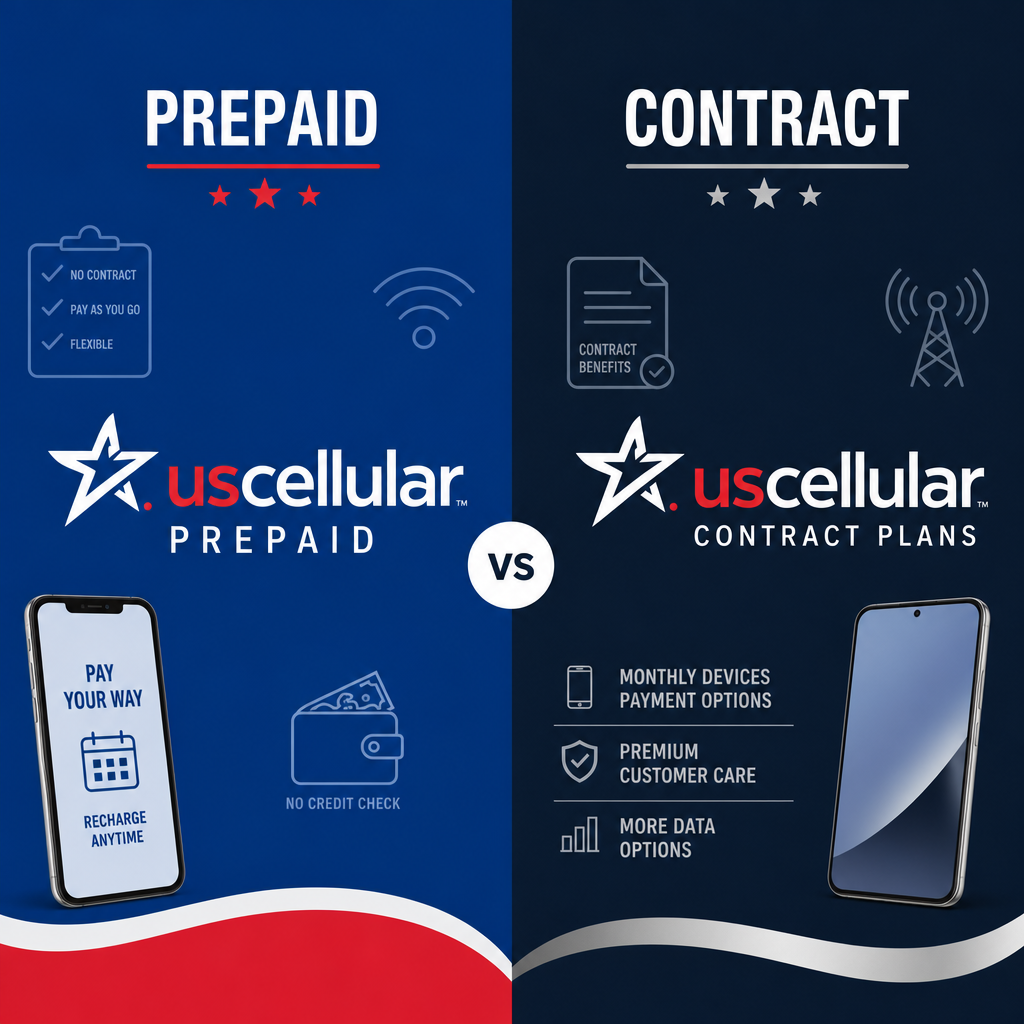
US Cellular Prepaid vs Contract Plans: Decision Maker Comparison
Here is the quick breakdown of how things look right now.
| Feature | US Cellular Prepaid | US Cellular Contract (Postpaid) |
| Cost Per Line (1 Line) | $30 – $40 (Best Value) | $70+ (Premium Price) |
| Commitment | None. Cancel anytime. | 36 Months (Device Financing) |
| Network Coverage | Excellent. (Now includes T-Mobile towers). | Excellent. (Includes T-Mobile + Roaming partners). |
| Data Priority (Speed) | Low. Slows down in crowded stadiums/cities. | High. Stays fast even when busy. |
| Phone Deals | Pay full price (iPhone 17 is ~$800+). | “Free” Phones (iPhone 17 On Us via monthly credits). |
| The “Merger” Risk | Zero. If they change plans, you just leave. | Medium. You are locked in for 3 years while the company changes. |
US Cellular Contract vs Prepaid Cost Comparison
Let’s look at your wallet. The gap between Prepaid and Contract is wider than ever in 2026.
The “Bring Your Own Phone” Scenario
Let’s say you are happy with your current phone (maybe an iPhone 15 or Galaxy S24).
- Prepaid: You pay roughly $35/month.
- Total cost for 3 years: $1,260.
- Contract (Postpaid): You pay roughly $70/month.
- Total cost for 3 years: $2,520.
The Verdict:
You save $1,260 by choosing Prepaid. That is enough to buy a brand new phone in cash! If you already have a working phone, signing a Contract is financially a bad move.
The “New Phone” Scenario
You want the shiny new iPhone 17 or Samsung Galaxy S26.
- Contract: US Cellular will give you the phone for $0 (via bill credits). But you must stay for 36 months.
- Prepaid: You must pay $830 upfront for the phone.
The Verdict:
If you don’t have $800 cash today, the Contract acts like a 0% interest loan. It is the only way to get a flagship phone without hurting your bank account instantly.
The “Speed” Trap (QCI Explained)
This is the one downside of Prepaid that T-Mobile didn’t fix.
Wireless networks have a VIP list. It is called QCI (Quality of Service Class Identifier).
- First Class (Contract Users): When the tower is busy, these users get to go first. Their video loads instantly.
- Economy Class (Prepaid Users): When the tower is busy, these users wait.
Real World Example:
Imagine you are at a crowded high school football game.
- Contract User: Uploads a video to Instagram in 2 seconds.
- Prepaid User: The loading circle spins… and spins… and times out.
Do you need First Class?
- If you live in a rural area where towers are rarely full? No. Prepaid is just as fast as Contract.
- If you live in a dense city or go to big events? Yes. You will hate Prepaid during rush hour.
The “Future Proof” Problem
Here is the scary part about signing a Contract in 2026.
The 36-Month Lock:
US Cellular contracts are now 36 months (3 years). That is a long time.
Since T-Mobile now owns the brand, we don’t know exactly what plans will look like in 2027 or 2028.
If you sign a contract today, and T-Mobile decides to change the pricing structure next year, you are stuck. If you leave early, the remaining balance of your phone (which could be $600+) becomes due immediately.
Prepaid Safety:
With Prepaid, you have zero risk. If T-Mobile changes the plans next month and you don’t like it? You just switch to Mint Mobile or Verizon. You are a free agent.
Round 4: Customer Service & Stores
This has changed since the merger.
The Hybrid Store:
If you walk into a US Cellular store today, you might see them selling T-Mobile Home Internet. The staff is trained on both systems now.
- Contract Users: You still get priority support. You can call 611 and get a human fairly quickly.
- Prepaid Users: You are often pushed to use the App. If you have a complex billing issue, you might spend 45 minutes on hold.
The “Tech-Savvy” Rule:
Are you good at fixing your own problems? Can you swap a SIM card yourself? If yes, get Prepaid.
Do you need someone to help you transfer your contacts and set up your email? Pay the extra money for Contract.
US Cellular Prepaid vs Contract: Specific Recommendations
For The Senior Citizen
Winner: Prepaid
Most seniors value safety and basic communication. They don’t need “Priority Data” for 4K streaming.
- Why: The new T-Mobile coverage means their phone will work in more places than before.
- Plan: Look for the basic Talk & Text or 5GB Prepaid plans. They are a fraction of the cost of a Contract.
For The Family of 4
Winner: Contract
- Why: Postpaid plans offer massive discounts when you add more lines. A single line is $70, but 4 lines might drop to $35/line.
- Bonus: You can likely get 4 free new phones for the kids. That is $3,000 worth of hardware for “free.”
For The Credit Builder
Winner: Prepaid
Contract plans require a Hard Credit Check. If you are young or rebuilding credit, this can hurt your score.
- Why: Prepaid has No Credit Check.
- Perk: US Cellular Prepaid has a “Grace Period.” If you are late on a bill, they keep your line active for a few extra days. Postpaid plans will just hit you with late fees.
US Cellular Prepaid vs Contract Reddit
I checked the latest threads on r/USCellular and r/NoContract to see what real people are experiencing post-merger.
“Data speeds are way better now.”
Many Prepaid users report that since the T-Mobile towers opened up to them, their signal bars have doubled.
“Don’t buy the cheap prepaid phones.”
Users warn against buying the cheap $40 phones on the prepaid rack. They are slow. Pro Tip: Buy a refurbished iPhone 14 or 15 online, and then put it on a Prepaid plan.
US Cellular Prepaid vs Contract: The Winner Is…
In 2026, the gap has closed. The “bad coverage” on Prepaid is gone.
Pick US Cellular Prepaid If:
- You want to save $400+ a year.
- You hate being locked into 3-year agreements.
- You don’t need the absolute fastest data speeds in crowded stadiums.
Pick US Cellular Contract If:
- You need a brand new phone and can’t pay cash.
- You have a large family (3+ lines).
- You rely on your phone for business and cannot risk “deprioritized” data.
My Advice:
Unless you need a new phone today, start with Prepaid. The network is better than it has ever been, and the freedom to leave is priceless during this transition period.
Frequently Asked Questions
1. Is US Cellular going away?
The brand is transitioning. While T-Mobile owns the operations, the “US Cellular” name is still on plans for now. Eventually, you may be migrated to a T-Mobile plan, but your service won’t just cut off.
2. Can I use a T-Mobile phone on US Cellular Prepaid?
Yes! Since the merger, device compatibility is excellent. An unlocked T-Mobile phone will work perfectly on US Cellular plans.
3. Does Prepaid get 5G?
Yes. You get full access to the 5G and 5G+ (Mid-band) network. The only difference is priority, not technology.
4. What is the unlocking policy?
This is a big one.
- Prepaid Phones: Locked for 12 months.
Contract Phones: Locked for 120 days (usually).
If you plan to sell your phone next year, Contract phones hold their value better because they unlock sooner.