


Businesses today need reliable phone service but also want to keep costs low. Old-fashioned phone systems were expensive and hard to manage. Today, many cheap business phone service providers offer modern VoIP (Voice over Internet Protocol) plans that work over the internet. These cloud-based phone services can save small businesses money. In fact, switching to a cloud phone system can cut your phone bill by around 40–60% compared to an old landline system.
Cloud phone systems let you use headsets or mobile apps instead of pricey desk phones. Since the calls go over the internet, companies can avoid buying and maintaining expensive phone hardware. The cloud provider handles updates and fixes, so your team doesn’t waste time on repairs. You also get advanced features that save time and money – for example, many plans include free online faxing or voicemail transcription. In short, phone service providers for business now focus on giving these features at a fraction of the cost of old systems.
Cheap Business Phone Service Providers: Key Benefits
Choosing cheap business phone service providers means looking for providers that give full features for less money. Many modern VoIP plans cost about $15–$25 per user per month. This includes unlimited domestic calling (often in the US and Canada) and useful tools like auto-attendants, call routing, and business texting. For comparison, older analog or legacy business phone lines often cost $40–$55 per line plus long-distance charges. With VoIP, there are no separate fees for local calls – local and international calls can be much cheaper.
Cost savings: Many companies save up to 60% by moving to VoIP phones. For example, Nextiva (a top provider) notes that cloud services can lower phone bills dramatically. Even some cable or internet providers (like Comcast Business or local fiber companies) now include business voice plans, so shopping around for bundle deals can help small businesses cut costs.
Flexible features: Cheap VoIP systems still offer rich features that big companies use. You can get voicemail-to-text, auto-attendants, web conferencing, and more on affordable plans. Many providers include built-in texting, video meetings, and call analytics at no extra fee. These extras can boost productivity and customer service.
Reliability and support: Modern VoIP companies often promise high uptime (over 99.9%). Because the system is online, calls can automatically reroute if something goes wrong. You also usually get 24/7 support, which means real people are available to help, not just machines. This is a change from old business lines, where a local outage could hit you hard.
However, even cheap plans have limits. Many cheap VoIP service for business plans restrict some features or support levels. For instance, the very lowest-cost plans may lack advanced call recording or international dialing. Also, watch out for hidden fees: setup fees, number porting fees, or special features (like extra toll-free numbers) may cost extra. Overall, a low monthly price often comes with less flexibility or support. But for many startups or home offices, a basic cheap plan has everything they need.
Choosing the Right Features
When comparing small business phone service providers, keep the following in mind:
- Monthly Price: Check if the price is per user or per line, and if taxes/fees are extra. For example, Vonage Business plans start at about $13.99 per user. RingCentral’s plans start around $19.99, often billed annually. Google Voice for Google Workspace starts at $10 per user (for the first 10 users), making it one of the cheapest options.
- Included Minutes: Confirm if unlimited calling in the US (and maybe Canada) is included. Many plans like Nextiva’s include unlimited domestic calling.
- Hardware Needs: Some providers include VoIP desk phones, others expect you to use your own devices or softphones (apps on mobile/PC). Cheaper plans often let you use free apps or your own SIP phones. For example, with Nextiva you can use a mobile app or a web browser to make calls.
- Contracts vs. Month-to-Month: Cheap plans might require a year contract for the lowest price. If you want flexibility, pay month-to-month and expect a slightly higher rate.
- Essential Features: Look for things like voicemail-to-email, auto attendants, call queues, mobile apps, and call recording. Some providers include all these on even their basic plans. For example, Nextiva’s basic plan ($18.95) includes unlimited calling, unlimited Internet faxing, and 99.999% uptime.
In short, the best small business phone service providers will balance price with the features you need. A plan that is cheap per line but forces you to pay for every little add-on might not actually save money in the long run. Always check what is included.
Top Cheap Business Phone Service Providers

Here are some widely recommended low-cost options for business phone service:
- Nextiva: A popular cloud phone provider. Their basic VoIP plan starts at $18.95 per user/month, which includes business texting, local and toll-free numbers, and voicemail transcription. Nextiva offers free unlimited domestic calling and many advanced features (IVR, call recording, CRM integration, etc.) in higher tiers. Many sources call Nextiva one of the cheapest and most reliable services. It is often noted as the best overall choice for small businesses due to value and support.
- RingCentral: Known for a full-featured system. RingCentral’s standard plan is about $20 per user/month (billed annually). You get unlimited calling, team messaging, and video meetings. Its lower-tier “Core” plan can cost as little as $9.99 for 1–5 users, though volume pricing raises it. RingCentral includes unlimited domestic calling, auto-attendants, and smartphone apps on all plans. It’s rated best for businesses that want everything in one place (voice, video, chat).
- Ooma Office: A budget-friendly choice with no contracts. Ooma’s Essential plan starts at $19.95 per user/month. This plan gives unlimited calling in the US, Canada, Mexico, and Puerto Rico. Ooma includes unlimited calling, voicemail-to-email, virtual receptionist, and mobile app. Its pros are ease of use and low cost; however, its advanced features (like multi-level auto-attendants) may need higher tiers. Overall, Ooma is often cited as the “cheapest” virtual phone service for small teams.
- Vonage Business: Offers a mix of voice and communication channels. Vonage plans start around $13.99 per user/month, making it one of the lowest-priced brands for business VoIP. This includes unlimited US/Canada calling and supports multiple channels like SMS and apps. Vonage’s system is easy to scale as you grow. One downside: some advanced features cost extra.
- Google Voice (for Google Workspace): If your business uses Google Workspace, you can add Google Voice as a phone solution. The Starter plan is $10 per user/month for up to 10 users (other plans allow unlimited users). Google Voice includes unlimited domestic calling and works on all your devices. It’s very low cost. It lacks some enterprise features, but it is easy for small teams. It even offers a free tier for personal use with unlimited calls in the US/Canada (though the free version has limitations).
- Grasshopper: Designed for solo entrepreneurs or small teams. Grasshopper’s plans begin at about $14 per month for a single number. You get a virtual business phone number with call forwarding, voicemail, and texting. It’s a virtual phone system rather than full VoIP, but it’s simple and inexpensive if you only need one or two numbers.
- Zoom Phone: If you already use Zoom, their Phone plan is priced around $10 per month (billed yearly). It includes a Zoom app-based phone system with unlimited calling. Zoom Phone also has AI features and global reach. For small businesses, it can be one of the most affordable VoIP options especially if you want a meeting/call solution together.
- Dialpad: More known for tech startups. Dialpad’s entry plan is $15 per user/month. It gives unlimited US/Canada calling and supports AI features like voice transcripts. It’s fairly low-cost and easy to set up yourself online.
- 8×8: While 8×8 is usually used by larger teams, its lowest plan can be competitive if you want an all-in-one system with unlimited calling. Pricing starts around $15–$20 user/month, depending on promotions (8×8 often negotiates custom pricing). They emphasize secure global calling and analytics. 8×8 is generally known for value on plans rather than being the absolute cheapest.
Each of these providers has its own strengths, but all are considered affordable for small businesses. In many reviews, Nextiva, RingCentral, and Ooma consistently top the list of best cheap business phone services. Vonage and Google Voice often appear for businesses looking to spend very little. The cheapest business VoIP phone service on the market depends on your needs: for one or two users Google Voice or Grasshopper may be cheapest, while Nextiva and RingCentral offer the best deal for more users and features.
Cheap VoIP Service for Business: Pros and Cons
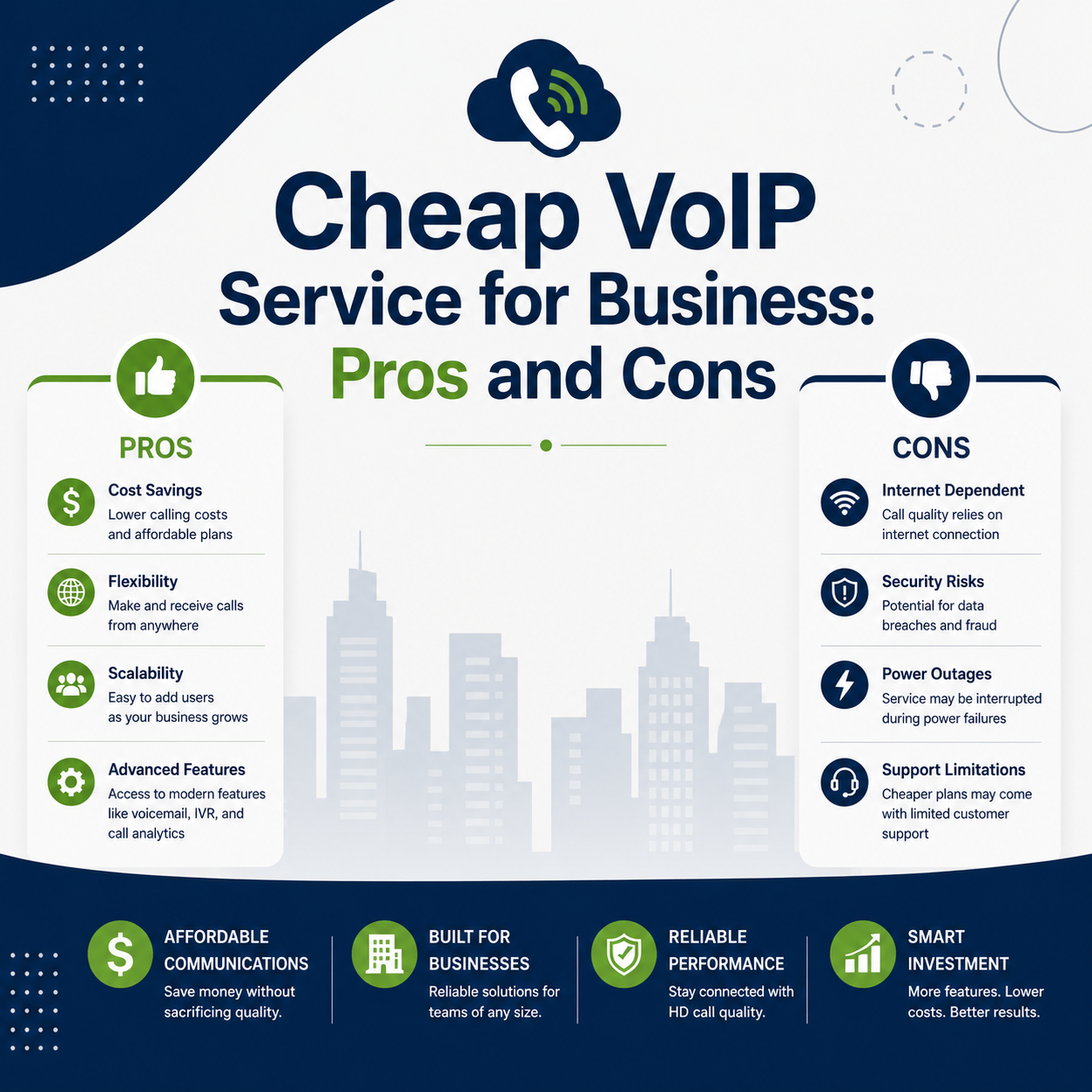
Using a cheap VoIP service for business has trade-offs:
- Pros: The biggest pro is the low monthly cost. You only pay for the lines you use, and initial setup costs are often minimal. Cheap providers often allow you to start with a few users and then add more as you grow. Many of them include free calls within the US (and sometimes Canada) as part of the plan. For very small teams or home offices, a free or low-cost VoIP plan might meet all needs without paying for features they don’t use.
- Cons: Very low-cost plans often omit features and support. Hidden fees can erode savings – for example, you might need to pay to keep your number or to port an existing number over. There is often no SLA (service level agreement), meaning no guaranteed uptime and limited customer support. Cheap plans may exclude features like international calling, toll-free numbers, or advanced call recording. Security can be an issue too, since encryption and privacy options may be weaker on free/cheap services. In general, “you get what you pay for” – so if absolute reliability and all bells-and-whistles are needed, a low-end plan might fall short.
To make the most of a cheap VoIP plan, choose a reputable provider that offers transparency about fees and includes at least the essential features you need (like unlimited calling, mobile apps, and voicemail). Also compare providers on the basis of support and reviews. Remember, even if the monthly fee is low, downtime or missing features could cost more in lost business.
Finding Providers in Your Area
You might wonder about business phone service providers in my area or near me. When you Google these terms, you’ll often see national companies (like AT&T, Verizon, Comcast) and even local cable or internet providers. These big carriers offer phone lines too, but their small-business plans often charge higher rates or require expensive bundles. However, it’s worth checking local options, especially if you have community fiber or a regional VoIP host.
For example, some local telecom companies offer hosted PBX or VoIP that could be cheaper in your region (often advertised as saving “up to 50%” over legacy lines). Local vendors might have better support for your area code and can sometimes bundle with your internet.
That said, most cheap business phone service providers operate online and serve the entire country or world. You don’t usually have to find one “near me” physically. You can sign up, and then pick phone numbers (local or toll-free) for your region. Large VoIP providers like Nextiva, RingCentral, 8×8, and others offer numbers in many area codes. So even if you search “near me,” the cheapest option might still be a national VoIP company.
How to Pick the Best Cheap Business Phone Service Provider
To pick the best provider for your budget, compare factors side by side. Here are steps and tips:
- List Your Must-Haves: Decide how many lines or users you need, and what features you cannot live without (for example: mobile app, SMS texting, call recording, or a toll-free number).
- Check Pricing Plans: Look at the entry-level plan price and what it includes. Remember to note if the price is monthly or requires an annual contract. For example, Nextiva’s basic plan is $18.95/month, while Google Voice is $10 for small setups. If a plan seems very cheap, verify if it’s truly unlimited or has caps.
- Compare Features: See if each plan provides unlimited calling (usually domestic). Check extras like “find me follow me,” voicemail transcription, or integration with software you use. As one source notes, modern providers give “sophisticated call routing and forwarding” and lots of added services, often included in base plans.
- Trial or Demo: Many providers offer free trials or demo calls. Take advantage of these to test call quality and ease of use. Dialpad and Vonage, for example, allow quick setup to try their service.
- Read Reviews: Look up recent reviews (like on G2 or other sites). See what real small businesses say. For instance, experts often say “Nextiva is one of the best small business phone service providers”.
- Local Number Coverage: Ensure the provider can supply phone numbers for your business location. Most VoIP companies can, but if you’re really small, even a Google Voice local number might suffice.
- Customer Support: Even for cheap plans, good support is a plus. Check if the provider has 24/7 phone support or local agent help. This is important if anything goes wrong.
- Future Growth: If you plan to grow, check how easy and costly it is to add new users or features. Most cloud systems let you add lines instantly, but make sure pricing stays reasonable as you scale.
By going through these steps, you’ll find which cheap business phone service providers fit your needs. Remember, the goal is to get necessary features at a low cost without hidden extras.
Business Phone Service Providers “Near Me”
When you search for business phone service providers near me, you might see many results that are national or unrelated. Often this includes big companies like Xfinity, Verizon, or even web pages by marketing firms. These might not necessarily be cheaper.
Instead, try searching by country or city (for example “business VoIP providers in the USA” or your country). Many cloud phone providers serve everywhere. If your company is outside the US, look for global players like RingCentral, Zoom, or local VoIP providers in your country. Check for providers with local support in your region. Also, consider small local IT companies – some manage VoIP solutions for nearby businesses, and they might have special packages or managed service deals.
Conclusion
Cheap business phone service providers give small companies a big advantage. Using VoIP and cloud technology, you can get full-featured phone service at a low monthly cost. Top providers like Nextiva, RingCentral, Ooma, Vonage, Google Voice, and Zoom Phone are frequently highlighted as the best low-cost options. Plans starting around $10–$20 per user cover most small business needs.
In summary, to find the right cheap business phone service providers, identify your budget and essential features first. Then compare providers and plans carefully. Check for unlimited calling and needed tools (like auto-attendant or mobile apps). Always watch for extra fees. By doing your homework, you’ll uncover the best small business phone service providers that fit your budget. Whether you search “business phone service providers near me” or simply compare online, you’ll find plenty of affordable options. In conclusion, the cheapest business phone solutions today rely on VoIP and cloud systems – they can save you up to 60% on phone bills while still giving you advanced calling features. With so many low-cost providers available, a small business can get reliable, full-featured phone service without breaking the bank.
Sources: We gathered information from industry experts and provider data. For example, one vendor notes that Nextiva’s basic VoIP starts at $18.95/month, and business VoIP can slash bills by up to 60%. Other reviews similarly list pricing and features of top providers, ensuring this guide is up-to-date and comprehensive. All claims are backed by these sources.
These are some of the best small business phone service providers in georgia, oklahoma, california, texas, or wherever you are in the globe. they are everywhere just a click away from you!